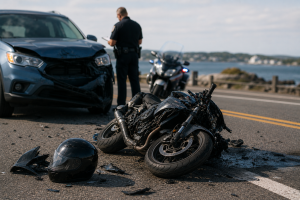
 Motorcycle riders in Plymouth and across Massachusetts deal with something that car accident victims rarely face: a built-in bias that can quietly work against them from the moment an accident happens. It shows up in how police reports are written, how insurance adjusters approach the claim, and sometimes in how juries perceive the case. Understanding this bias is not about being cynical. It is about being prepared, because a Plymouth personal injury attorney who handles motorcycle cases knows this is real and knows how to address it.
Where the Bias Comes From
There is a cultural assumption, held by a surprising number of people including some who end up on juries, that motorcycle riders are inherently reckless. The image of a rider weaving through traffic at high speed gets attached to every motorcyclist, even those who ride carefully and within the law for years without incident. When an accident happens, that assumption can color everything.
Studies on juror attitudes in motor vehicle cases have consistently shown that juries tend to assign more fault to motorcycle riders than the evidence supports. Adjusters know this. Defense attorneys know this. And it affects how cases are valued and how vigorously they are defended, even when the rider did nothing wrong.
How Bias Shows Up in Police Reports
Officers who respond to motorcycle accidents are human beings with the same cultural conditioning as everyone else. Research into traffic crash reports has found that officers sometimes describe rider behavior using language like “aggressive” or “erratic” that would not appear in a report about a car driver in the same situation. A rider who was traveling at the speed limit may be described in terms that subtly suggest fault. A driver who failed to yield may get more charitable language.
This matters because the police report is often the first piece of evidence that shapes how an insurer approaches the claim. If the language in that report tilts against the rider even slightly, it can set a tone that is hard to reverse. A personal injury lawyer in Plymouth who handles motorcycle accident cases knows how to analyze the report critically, gather independent witness accounts, and push back when the documentation does not match what actually happened.
The Gear Question and Contributory Negligence
What a rider was wearing at the time of an accident almost always comes up. Massachusetts does not require adult motorcycle riders to wear full protective gear beyond a helmet, but the absence of protective clothing can be used by defense attorneys to suggest the rider contributed to the severity of their own injuries.
This is a version of the same argument used against cyclists who are not wearing helmets, though the law treats it differently depending on the state. In Massachusetts, the contributory negligence framework means that if you are found partially at fault for your injuries, your recovery can be reduced by that percentage. Defense teams know that raising the gear issue, even when it is legally marginal, can shift jury sentiment.
A good Plymouth personal injury attorney counters this by making sure medical experts explain clearly which injuries were caused by the collision itself versus which ones the gear question is even relevant to. In many cases, protective gear would not have changed the outcome at all given the nature of the impact. That needs to be clearly established rather than left open to assumption.
Lane Filtering and the Legal Gray Zones
Massachusetts does not currently allow lane splitting or lane filtering, the practice of riding between lanes of slow or stopped traffic. But riders sometimes get involved in accidents near intersections or merge points where their positioning is questioned after the fact. Even if a rider was technically in a legal position, opposing counsel may try to characterize their location in traffic as unusual or aggressive.
These are the kinds of technical arguments that require thorough accident reconstruction and someone who understands both traffic law and motorcycle dynamics. Not every personal injury lawyer has that experience. When choosing a Plymouth personal injury attorney for a motorcycle case, asking specifically about their track record with motorcycle claims is worth doing.
Underinsured and Uninsured Driver Problems
Motorcycle accident injuries are frequently severe. The physics of a collision between a motorcycle and a passenger vehicle, even at modest speeds, often produce serious orthopedic, spinal, and traumatic brain injuries. The medical costs associated with these injuries can be substantial, often exceeding what the at-fault driver’s policy will cover.
This is where uninsured and underinsured motorist coverage becomes critically important for riders. Massachusetts law requires insurers to offer this coverage, and whether a rider has it on their own policy can dramatically affect what they are able to recover. A personal injury lawyer in Plymouth will look at all available insurance coverage across all parties, not just the at-fault driver’s policy, to make sure every potential source of compensation is identified and pursued.
Documenting Your Case Before Evidence Disappears
Physical evidence from motorcycle accidents degrades quickly. Skid marks fade. Debris gets cleaned up. Damage to the other vehicle may be repaired. Road conditions that contributed to the crash may be fixed. Witnesses may not remember details as clearly a month later as they did the day it happened.
Acting quickly after a motorcycle accident in Plymouth is genuinely important, and not just because of the statute of limitations. The sooner an attorney gets involved, the sooner a thorough investigation can begin. That includes getting to the scene, gathering evidence, identifying any cameras in the area, and locking down witness statements while they are still reliable.
If you were injured in a motorcycle accident in Plymouth, you are already dealing with the bias problem whether you know it or not. A Plymouth personal injury attorney who understands how that bias operates is your best resource for making sure the facts of your case are the ones that drive the outcome, not a cultural assumption about who you are for riding a motorcycle.