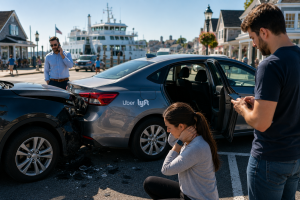
 Cape Cod summers bring an enormous volume of rideshare traffic. People use Uber and Lyft to get to and from the Hyannis ferry docks, to hop between restaurants on Main Street without parking headaches, and to get home safely after a night out. During peak season, rideshare vehicles are everywhere on the roads around Hyannis, and with that volume comes the occasional crash.
What most people do not realize until they are actually dealing with the aftermath is that an accident involving a rideshare vehicle does not work like a normal car accident claim. The insurance question alone is genuinely more complicated, and making the wrong move early on can cost you significantly. A personal injury lawyer in Hyannis who handles these cases can walk you through the specifics, but here is a solid foundation to start from.
The App Status at the Time of the Crash Changes Everything
This is the part that catches most people off guard. The compensation available to you does not depend solely on who caused the accident. It also depends on exactly what the driver was doing in the Uber or Lyft app at the moment the collision occurred. There are three distinct situations, and each one triggers a different set of coverage.
If the driver had the app closed entirely, you are dealing with their personal auto insurance only. The rideshare company has no involvement, and the claim proceeds exactly like any other crash between private motorists.
If the driver had the app running and was waiting for a trip request but had not accepted one yet, Uber and Lyft each carry what is called contingent liability coverage. In Massachusetts this covers up to $50,000 for injuries per person and $100,000 per incident for bodily harm, along with $25,000 toward property damage. The catch is that this coverage only activates if the driver’s own personal policy declines the claim or does not have sufficient limits to cover it.
If the driver had accepted a trip or was actively carrying a passenger, the full commercial policy is in play. That means $1,000,000 in liability coverage, plus uninsured and underinsured motorist protection on top of that. Massachusetts specifically addressed this back in 2016 when state law began requiring rideshare companies to carry that level of coverage for active trips. It was a meaningful protection for anyone sharing the road with these vehicles.
One of the first things a Hyannis personal injury attorney does in a rideshare case is pin down exactly which phase applied. Rideshare companies keep detailed trip logs that record app activity down to the minute, and preserving that data early is important before it becomes harder to access.
Passengers Are in the Strongest Position
If you were a passenger in the rideshare vehicle at the time of the accident, you are generally looking at the most favorable coverage scenario. The million-dollar commercial policy is active the moment a driver accepts a ride request, so once you are in that car, you are protected at that level regardless of whether your driver caused the crash or another vehicle did.
Another advantage for passengers specifically is that comparative negligence arguments rarely apply to you. Since you had no control over the vehicle or the circumstances leading to the crash, there is very little for an insurance company to point to when trying to assign you a share of the blame. Your role in the claim is straightforward: you were a passenger, you were hurt, and you are entitled to compensation for that.
When You Were in a Different Vehicle That Got Hit
Being struck by a rideshare driver who was mid-trip actually puts you in a better position than being hit by most private drivers. The standard minimum liability coverage in Massachusetts is $20,000 per person, which can fall well short of covering serious medical bills. When the at-fault driver happens to be actively working for Uber or Lyft, that $1,000,000 commercial policy is available to compensate you instead.
The challenge is establishing which phase the driver was in, since rideshare companies do not always volunteer that information quickly. Getting legal representation involved early means someone is actively working to obtain and preserve the trip records before any disputes arise about what the driver’s status actually was.
Rideshare Drivers Who Are Injured on the Job Face a Different Problem
Drivers who get hurt while working for a rideshare company run into a complication that stems from how these companies classify their workers. Because Uber and Lyft treat drivers as independent contractors rather than employees, traditional workers’ compensation coverage does not apply in most situations. That means an injured driver cannot simply file a workplace injury claim and expect the company to cover their medical bills and lost income.
What matters most in this situation is who caused the crash. If another motorist was at fault, the injured driver pursues a claim against that person’s insurance. If that coverage falls short, the uninsured and underinsured motorist protection that Uber and Lyft maintain during active trips may fill some of the gap. A personal injury lawyer in Hyannis can audit all of the available coverage and make sure nothing is overlooked, because the difference between a partial recovery and a full one often comes down to knowing which policies to pursue and in what order.
Why These Cases Take More Time Than a Standard Claim
A typical two-car accident involves two insurance companies at most. A rideshare accident can involve three or more: the company’s commercial insurer, the driver’s personal carrier, and potentially the insurer of another at-fault vehicle. Each one is looking to limit its own payout, and they frequently dispute which policy should apply or whether coverage conditions have been met.
There is also an evidence preservation angle that does not come up in ordinary crashes. Your trip receipt, the in-app communication history with your driver, screenshots of your ride status, and the driver’s trip records from the platform are all potentially relevant. This information should be saved immediately after the accident, before app data gets purged or accounts get flagged.
A Hyannis personal injury attorney with rideshare experience knows how to coordinate across multiple parties simultaneously while making sure none of them delays the process at your expense. Given the substantially higher coverage ceilings involved compared to typical personal auto policies, handling these cases correctly can mean a dramatically different outcome for someone who was seriously hurt.
Do Not Assume the Rideshare Company Is Going to Handle This for You
One of the most common mistakes people make after a rideshare accident is assuming that because they were using the app, the company will take care of things. That is not how it works. Uber and Lyft have third-party claims administrators who handle injury claims on their behalf, and those administrators operate with the same goal as any other insurance-side adjuster: keep payouts as low as possible.
If you were hurt in any capacity in a rideshare accident near Hyannis, whether as a passenger, an occupant of another vehicle, a cyclist, or a pedestrian, a free consultation with a personal injury lawyer in Hyannis will give you a clear picture of what your claim is actually worth and what steps to take before you say anything to any insurance company involved.