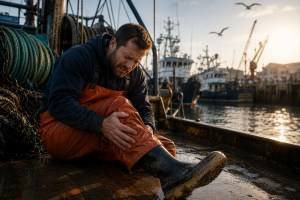
 Picture two people who get hurt on the same Tuesday morning in New Bedford. One gets rear-ended on Acushnet Avenue. The other slips and falls on the deck of a fishing vessel heading out of the harbor. Both are hurt through someone else’s negligence. Both have medical bills and missed work staring them down. But from the moment those accidents happen, their legal situations are completely different in ways that most people, and honestly most general practice attorneys, do not fully understand.
New Bedford is not a typical city for injury law. It is one of the busiest commercial fishing ports in the country. Its harbor handles hundreds of millions of dollars in catch every year. The workforce that runs this industry, the fishermen, deckhands, processing crews, and vessel operators, faces physical risks that most workers never encounter, and when they get hurt, the law that covers them is not the law most people picture when they think about personal injury claims. As a personal injury lawyer in New Bedford, the cases that arise from this city’s working waterfront are among the most specialized and highest-stakes that come through the door.
Why the Water Changes Everything Legally
The moment an injury happens on navigable water, a body of federal law that predates the Constitution takes over. American maritime law has its roots in centuries of seafaring tradition and exists entirely outside the state tort system that handles car accidents, slip and fall cases, and most other personal injury claims. That means the rules your neighbor used when they sued after their car accident are largely irrelevant to what happens to a deckhand hurt on a vessel offshore.
This is not just a technicality. It changes who you can sue, what you can recover, how long you have to file, and what your employer is obligated to provide you while you recover. Getting legal advice from someone who handles general personal injury but has never touched a maritime case is a bit like seeing a general practitioner for something that requires a specialist. The fundamentals overlap, but the details are what determine the outcome, and the details here are entirely different.
What Federal Law Gives Commercial Fishing Workers That State Law Does Not
Workers injured in most industries file through the state workers’ compensation system. That system is a trade-off: it pays medical bills and a portion of lost wages without requiring you to prove your employer did anything wrong, but it also caps what you can recover and takes pain and suffering completely off the table. For most workers, it is the only route available.
For people who qualify as crew members under federal law, that trade-off does not apply the same way. A federal statute passed in 1920 that still governs maritime employment gives qualifying crew members the right to pursue their employer directly for negligence, the same way a pedestrian can sue a driver who hit them. Pain and suffering, full lost wages, future earning capacity: all of it is on the table in a way that simply does not exist in state workers’ compensation. The threshold for proving that negligence contributed to the injury is also deliberately lower than in a typical negligence case, reflecting Congress’s recognition that commercial maritime work is uniquely dangerous and that workers deserve strong protections.
Whether someone qualifies for these protections depends on how much of their work time was spent contributing to the mission of a vessel in operation. This is a nuanced legal question with a significant body of case law behind it, and it is one of the first things a New Bedford personal injury attorney who handles maritime cases will evaluate.
A Right That Exists Regardless of Fault
Beyond the negligence claim, maritime law also gives qualifying crew members a right to have their medical treatment covered and their basic living expenses supported during recovery, and this right does not depend on proving anyone did anything wrong. It exists simply because the worker was hurt while working on the vessel.
The medical coverage piece continues until a doctor determines the worker has gotten as much better as they are going to get. The living expense component is a modest daily amount meant to cover housing and food while the worker is sidelined. Neither is a windfall, but together they provide a baseline of support that state workers’ comp does not always match, particularly for injuries that keep someone out of work for months.
What surprises most people in New Bedford’s fishing community is that employers who refuse or delay these payments when they are owed can face additional legal consequences on top of the underlying injury claim. Many commercial fishermen never pursue these benefits at all because nobody has told them they exist. A personal injury lawyer in New Bedford familiar with maritime work will make sure these entitlements are identified and pursued from the beginning of a case, not discovered months in after money has already been left behind.
When the Vessel Itself Is the Problem
Some maritime injuries happen not because the employer did something negligent in the conventional sense, but because the vessel or its equipment was simply not safe to work on. A deck that has no grip in wet conditions. A winch that has not been properly maintained. A net or line that is frayed and should have been replaced. Lighting in a working area that makes nighttime operations genuinely hazardous.
Maritime law treats these situations through a doctrine that holds vessel owners to a strict standard of keeping their ships and gear fit for the work being done on them. This is a stricter standard than ordinary negligence. It does not require showing that the owner knew about the problem or should have known. If the condition existed and caused the injury, that can be enough. For workers hurt by equipment or vessel conditions rather than by a specific human error, this doctrine can be the foundation of a stronger case than a straight negligence argument alone.
Recreational Boating Is a Separate Category With Its Own Complications
Not everyone on New Bedford’s water is a commercial fisherman. Summer brings recreational boaters, sailing enthusiasts, passengers on charter fishing trips, tourists on harbor tours, and kayakers exploring the coastline. When accidents involving these recreational users occur, the legal picture is different from the commercial maritime framework but still meaningfully different from a car accident case.
Boat operators are responsible for the safety of their passengers and for operating their vessels without putting others on the water at risk. Collisions, wake damage, improper speed in congested areas, and inattentive operation are all sources of liability when they result in injury. The summer concentration of recreational and commercial traffic in New Bedford’s harbor, with whale watching vessels, fishing charters, commercial freighters, and recreational boats all sharing the same water, creates genuine hazards that a negligent operator can exploit in ways that hurt real people.
The Deadline Problem That Catches People Off Guard
Most people in Massachusetts know that personal injury claims have a three-year window. What they do not know is that water-based injuries sometimes come with dramatically shorter filing windows depending on who you are suing and under what legal theory. Certain maritime claims against vessel owners, and virtually all claims involving government-owned vessels or federally regulated waterways, can have notice requirements and filing deadlines that are measured in months rather than years.
This is not a mistake you can recover from. Once a maritime deadline passes, the claim is gone regardless of how clearly the other party was at fault and how serious the injuries were. If you were hurt on the water in or around New Bedford this summer, getting legal advice quickly is not just smart practice. In some situations it is the difference between having a case and not having one.
Contact a personal injury lawyer in New Bedford today for a free consultation. The water is central to this city’s identity and its economy, and the people who work on it and enjoy it deserve legal representation that actually understands the rules that apply to them when things go wrong.