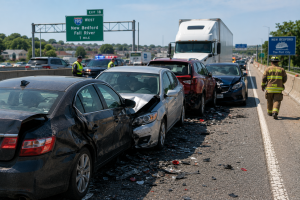
 Summer highway traffic in and around New Bedford creates some of the most dangerous driving conditions of the year. Route 195 funnels commuters, tourists, commercial trucks, and beach-bound traffic through a corridor that was not designed for this volume, and when something goes wrong at highway speed it rarely stays between just two vehicles. A sudden brake, a distracted driver two cars ahead, a truck that cannot stop in time, and suddenly three or four or five vehicles are involved in a chain-reaction pile-up that leaves multiple people injured, multiple cars destroyed, and multiple insurance companies pointing fingers at each other.
The question injured people ask a personal injury lawyer in New Bedford after these accidents is almost always the same: there were four cars involved, I was hurt, and I have no idea who is responsible for what. That confusion is completely understandable. Multi-car accident claims are among the most legally complex situations in personal injury practice, and the way they work is not intuitive. Here is how it actually breaks down.
Fault Does Not Have to Be All-or-Nothing
The first thing to understand is that Massachusetts does not require a single driver to be one hundred percent at fault for an accident in order for injured people to recover. The state uses a comparative fault system, which means responsibility for a crash can be distributed across multiple drivers in whatever proportions the evidence supports. Driver A might be sixty percent at fault for the initial collision. Driver B might be twenty-five percent at fault for following too closely. Driver C might bear fifteen percent for a late lane change that contributed to the chain reaction. Each of those percentages carries financial responsibility proportional to the driver’s share of blame.
What this means practically is that as an injured person, you may have valid claims against multiple drivers at the same time. You do not have to pick one. A New Bedford personal injury attorney handling a multi-car case will investigate what each driver did or failed to do in the moments leading up to the crash and build a picture of distributed fault that positions your claim against every party who shares responsibility.
Chain Reaction Accidents and the Question of First Cause
In a classic chain-reaction highway accident, the vehicle at the front of the pile triggers the sequence, but the drivers who follow are responsible for how they respond to developing road conditions. The law expects drivers to maintain enough distance from the car ahead to stop safely if that car stops suddenly. A driver who rear-ends the car in front of them during a chain reaction is generally responsible for that collision, even if the overall pile-up was set off by someone further ahead.
This creates a situation where multiple rear-end impacts produce multiple sources of liability working simultaneously. If you were the third car in a four-car chain reaction, you may have a claim against the driver who hit you from behind, a claim against the driver whose sudden stop triggered the sequence, and potentially additional claims depending on what contributed to why the first stop happened, whether that was a mechanical failure, a distracted driver, a road hazard, or something else entirely.
Untangling the sequence of events in a chain-reaction accident requires more investigation than a straightforward two-car crash. Witness accounts, vehicle data from any event recorders present, physical evidence from the road, and sometimes accident reconstruction experts are all part of building a clear timeline of what happened and who caused what part of it. A personal injury lawyer in New Bedford who starts this investigation early, while the evidence still exists and witnesses still remember the sequence clearly, is in a much stronger position than one who gets involved after months have passed.
Multiple Defendants Means Multiple Insurance Companies
When your claim runs against more than one driver, it runs against more than one insurance company, and those insurance companies do not coordinate on your behalf. Each insurer is protecting its own policyholder, each is looking to limit its own exposure, and in many cases each is quietly hoping that the other drivers in the accident absorb as much of the blame as possible. You are dealing with several separate businesses, each with their own adjusters, their own investigators, and their own incentives, none of which align with each other or with you.
Without legal representation, an injured person in this situation is simultaneously negotiating with multiple insurance adjusters who are all motivated to minimize what their company pays and to shift responsibility to the other drivers. Each one will present their own version of how the crash happened. Each one will emphasize the fault of the other drivers. And each one will be looking for reasons to reduce your claim or find ways to argue that you share fault yourself, because in Massachusetts that reduces what they owe you.
Having a New Bedford personal injury attorney manage all of those relationships at once is not a luxury in a multi-car accident. It is the only realistic way to prevent each insurer from playing the others off against each other while your compensation falls through the gaps.
When Policy Limits Are Not Enough to Cover Everyone
Multi-car accidents frequently produce more injured people than any single policy can cover. If four drivers are all hurt in a pile-up and the driver most responsible carries minimum liability coverage, the math does not work in anyone’s favor. Massachusetts minimum limits can be exhausted quickly when multiple people have serious injuries, which means some injured people will not be fully compensated from that driver’s policy no matter how strong their claims are.
This is when the full picture of available coverage becomes critical. Your own underinsured motorist coverage can step in when the at-fault driver’s limits are not sufficient to cover your damages. If any of the vehicles involved were commercial vehicles, their commercial policies carry significantly higher limits that may be available to injured parties. If road conditions, a construction zone, or a highway defect contributed to how the accident developed, additional defendants with their own coverage may enter the picture. A personal injury lawyer in New Bedford maps out every available insurance source from the beginning of a multi-car case specifically because no single policy is often enough.
What to Do at the Scene of a Multi-Car Accident
The chaos of a multi-car accident on a highway makes gathering information harder than in a straightforward two-car crash, but the same information matters and some of it matters even more. Get the names, license numbers, and insurance information of every driver involved, not just the one who hit you directly. Take photos of every vehicle in the accident, the damage to each one, and the overall scene showing the positions of the cars. If the accident happened on Route 195 or another highway with overhead cameras or toll infrastructure, note the location precisely so your attorney can request that footage before it is overwritten.
If anyone at the scene describes what they saw happen, and witnesses in multi-car accidents are often other drivers who watched the sequence from their own vehicles, get their contact information immediately. Their account of which car braked first, which car did not, and the order of the impacts is often the most valuable evidence available in these cases and it walks away from the scene when the witnesses do.
Contact a personal injury lawyer in New Bedford as soon as possible after a multi-car accident. The complexity of these cases makes early legal involvement especially important, and a New Bedford personal injury attorney who begins the investigation while the evidence is fresh gives you the best possible foundation for navigating what is genuinely one of the most complicated claim situations in personal injury law.