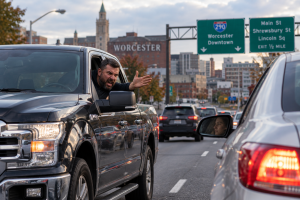
 In 2007, a former Worcester city councilor described the driving behavior she observed in the city as “rudeness that has accelerated,” noting that “rudeness and discourtesy have become routine” on Worcester’s streets. Nearly two decades later, that observation has only become more relevant. AAA Foundation for Traffic Safety surveys have found that nearly 80% of American drivers expressed significant anger, aggression, or road rage at least once in the past year. The combination of Worcester’s dense traffic, complex road geometry, and the stress of daily commuting has produced a driving culture that regularly tips into aggression.
Road rage is not just an unpleasant social phenomenon. It is a legal issue, and when aggressive driving causes a crash that injures someone, the legal consequences for the aggressor are often significantly more serious than in a standard negligence case.
What Road Rage Looks Like on Worcester Roads
Road rage incidents in Worcester follow patterns that drivers experience regularly, even if they do not always think of them in legal terms. A driver who tailgates aggressively and then rear-ends the car in front of them after a brake-check confrontation. A driver who intentionally cuts off another vehicle in a way that causes a collision or forces a swerve into a barrier. A driver who follows another driver, exits the highway together, and creates a dangerous confrontation that ends in a crash. A driver who runs someone off the road after a perceived slight at an intersection.
These are not accidents in the conventional sense. They are the result of deliberate choices made by someone who allowed anger to override their judgment, and the law treats them differently than purely accidental crashes.
Negligence Versus Intentional Conduct: Why It Matters for Your Claim
Most car accident personal injury claims are based on negligence: the other driver failed to exercise reasonable care. Road rage cases often involve something more than that. When a driver deliberately uses their vehicle to intimidate, harass, or harm another driver, that conduct may constitute intentional tortious behavior rather than simple negligence.
This distinction matters for several reasons. First, intentional conduct may allow a court to award punitive damages in addition to standard compensatory damages. Punitive damages are designed to punish especially egregious behavior and deter others from similar conduct. Massachusetts courts have the authority to award punitive damages in cases involving willful and wanton misconduct, and deliberate road rage that causes serious physical harm can meet that threshold.
Second, the driver’s insurance company may attempt to deny coverage for intentional acts. Auto insurance policies typically cover negligent conduct but may have exclusions for intentional harm. When this argument arises, your Worcester personal injury attorney will need to navigate it carefully, potentially by framing the claim in ways that invoke coverage while still accurately characterizing the driver’s conduct. This is exactly the kind of nuanced legal work that requires experienced local counsel.
Evidence in Road Rage Cases
Road rage cases are often won or lost on evidence, and the most valuable evidence frequently comes from sources that people do not immediately think about. Dashcam footage, if either driver had a dashcam installed, can be definitive. Security camera footage from nearby businesses, traffic cameras, and dashboard cameras in other vehicles that witnessed the incident can all provide objective documentation of what happened.
Witness testimony is particularly valuable in road rage cases because witnesses who were present during the lead-up to the crash may have seen behavior that preceded the actual collision, establishing the intentional or reckless nature of the aggressor’s actions. A personal injury lawyer in Worcester will work quickly to identify and contact witnesses while the event is still fresh in their memory.
The aggressor’s social media accounts, phone records showing any calls or texts in the moments before the crash, and any prior incidents of aggressive driving or traffic violations that establish a pattern can all contribute to building a compelling case.
When Road Rage Involves a Criminal Case
Serious road rage incidents in Massachusetts can result in criminal charges including assault with a dangerous weapon (the vehicle itself can qualify), leaving the scene of an accident, or reckless operation. When criminal charges are filed, the police and prosecution will gather evidence that can be invaluable to your civil personal injury case.
As noted earlier, a criminal case and a civil personal injury case are separate proceedings. The criminal case must meet the “beyond a reasonable doubt” standard. Your civil case needs only to meet a “preponderance of the evidence” standard, meaning it is more likely than not that the defendant’s conduct caused your harm. This lower threshold, combined with evidence gathered in the criminal process, often puts victims of road rage in a strong legal position to pursue full compensation.
Protecting Yourself in a Road Rage Situation
If you find yourself being targeted by an aggressive driver in Worcester, do not engage. Do not match their aggression, do not brake-check them, and do not make eye contact in ways that escalate the confrontation. Try to create distance between your vehicle and theirs. If the situation feels dangerous, drive to a police station, a busy public location, or call 911 while continuing to drive.
If a crash results despite your attempts to de-escalate, call 911 immediately. Document everything you remember about the other driver’s behavior before and during the crash. Photograph the scene, the vehicles, and any visible injuries. Identify witnesses. And contact a Worcester personal injury attorney as soon as you are physically able.
Road rage in Worcester is a real and growing problem. When it puts you in the hospital, you deserve more than a standard negligence settlement. A personal injury lawyer in Worcester can help you pursue every option the law makes available.