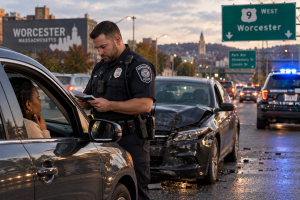
 The officer walks back to your window after running the other driver’s information. The look on their face tells you something before they say a word. The driver who just rear-ended you on Route 9, or ran the red light at Park Avenue, or sideswiped you coming off I-290, has no valid insurance. Or they have a policy so thin it would not cover a week of physical therapy, let alone the surgery your back is going to need.
For most people, that moment feels like the floor dropping out. You did not cause this. You were not the one driving recklessly. And now the financial system that is supposed to absorb these situations seems to have just disqualified itself.
What happens next is not what most people expect. And it is considerably better than that moment makes it feel.
Your Own Policy Was Built for This Situation
Every Massachusetts auto insurance policy includes coverage provisions that exist specifically because not everyone on the road is properly insured. These provisions have been a mandatory part of Massachusetts auto policies for years, and most drivers have no idea they are even there until something like this happens.
The first is what insurers call uninsured motorist protection. When the driver who caused your crash carries no insurance at all, this coverage steps in as the financial backstop. You file the claim through your own policy rather than chasing a driver who has nothing to give you. The money comes from your own insurer, which already has your premium payments and has been obligated all along to be there when this scenario arises.
The second provision addresses a different but equally common problem: the driver who technically has insurance, but whose coverage amounts to almost nothing. Massachusetts sets minimum liability requirements that were never designed to handle serious injuries. A driver carrying only the state minimum may have a policy that pays out a fraction of what a genuine injury claim is worth. When that gap exists between what their policy covers and what your actual damages are, a separate layer of your own policy, called underinsured motorist coverage, exists to bridge it.
Together these two protections mean that the financial fate of your recovery does not depend entirely on whether the person who hurt you happened to be responsible enough to carry adequate insurance. Your own policy was supposed to protect you in this situation. The question is making sure it actually does.
Why Filing Against Your Own Policy Still Requires a Fight
Here is the piece that surprises people the most. They assume that filing against their own insurer will be a cooperative, straightforward process. After all, they have been paying premiums loyally for years. Surely their own company will take care of them.
That is not typically how it works.
Your insurance company, like every insurance company, operates on the principle of paying out as little as possible on every claim. When you file an uninsured or underinsured motorist claim against your own policy, the adjuster handling your file has the same financial incentives to minimize your settlement as the adjuster working for the driver who hit you would have. They may challenge the severity of your injuries. They may question whether certain treatment was actually necessary. They may offer a number that is designed to close your file quickly rather than to reflect what your claim is genuinely worth.
The fact that they are your insurer does not make them your advocate. It makes them a party whose financial interests are in tension with yours, even when they are technically obligated to pay. A personal injury lawyer in Worcester who has handled these claims understands this dynamic intimately. They know how to push back, what evidence carries weight, and when to invoke the formal dispute resolution processes that Massachusetts insurance law provides when an insurer is not negotiating in good faith.
The Order in Which Things Happen Matters Enormously
Underinsured motorist claims in particular require navigating a specific sequence of steps, and getting that sequence wrong can have serious consequences for what you ultimately recover. In general terms, before your own underinsured motorist coverage becomes available, you need to have formally resolved the claim against the at-fault driver’s policy first, established that their coverage has been exhausted, and obtained your insurer’s consent before accepting that settlement. Skipping or misordering any of these steps can jeopardize your ability to access your own coverage.
This is not a process that most injured people should navigate alone, especially while also managing medical treatment and the practical disruptions that come with a serious injury. A Worcester personal injury attorney handles this sequencing as a matter of routine in these cases. They protect your access to every layer of coverage available and make sure procedural missteps do not cost you money you are legally entitled to.
Hit and Run Crashes in Worcester
A variation of this situation occurs when a driver causes a crash and disappears before police can identify them. Worcester sees hit and run incidents with some regularity, and in cases where the responsible driver is never found, the victim is left in a position where there is no opposing party to claim against at all.
Uninsured motorist coverage typically extends to hit and run situations, but the procedural requirements for preserving that claim are strict. Police need to be called and a report needs to be filed promptly. Your insurer needs to be notified within a specific timeframe. The physical contact requirements of your policy need to be satisfied. Missing any of these steps can result in a coverage denial that is very difficult to reverse.
Calling a personal injury lawyer in Worcester immediately after a hit and run gives you the best chance of preserving every available avenue for compensation from the first moment.
What This Situation Actually Costs People Who Handle It Alone
People who attempt to navigate uninsured and underinsured motorist claims without legal representation routinely leave significant money on the table. They accept the first offer because it sounds like a lot until they realize their medical bills exceed it. They miss the procedural steps that protect access to additional coverage layers. They give recorded statements to their own insurer that are later used to cap their recovery. They settle before the full extent of their injuries is known.
A personal injury lawyer in Worcester working on a contingency basis costs you nothing unless they recover money for you. The question is not whether you can afford legal representation. It is whether you can afford to go through this without it.
The driver who hit you may have had nothing. Your options for recovery are considerably better than that. Call a Worcester personal injury attorney and find out exactly what they look like for your specific situation.