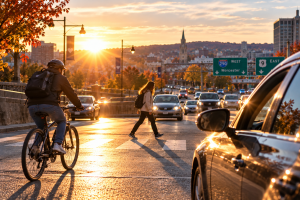
 There is a specific kind of accident that spikes every autumn in Worcester and across Massachusetts, and it does not get nearly the attention it deserves. It happens during the morning commute and again in the late afternoon. It involves a driver who claims they genuinely did not see the car, the pedestrian, or the cyclist in front of them. And in many cases, they are telling the truth, at least partially, because the low autumn sun was positioned directly in their line of sight and they were temporarily blinded.
Sun glare as a cause of traffic accidents is well-documented by traffic safety researchers. Studies have found that sun glare is a contributing factor in roughly 9,000 car accidents per year in the United States, resulting in approximately 100 fatalities annually. In the fall and spring, when the sun sits low on the horizon during peak commuting hours, that risk climbs significantly. Massachusetts is specifically named by CARFAX data as one of the states where autumn produces the highest accident rates, and low-angle sun glare during the shorter days of October and November is a significant part of why.
But here is the legal reality that surprises many people: being temporarily blinded by the sun does not automatically excuse a driver from liability when they cause a crash. And understanding why matters enormously if you were hurt in an accident involving a sun-blinded driver in Worcester this fall.
Sun Glare Does Not Remove a Driver’s Legal Duty
Massachusetts law imposes a duty of care on all drivers to operate their vehicles safely given the conditions they encounter. This duty extends to conditions a driver should anticipate encountering. A driver who knows they will be heading directly into a low autumn sun during a morning commute along a specific road is expected to take precautions: slow down, increase following distance, use sun visors, wear polarized sunglasses, and exercise extra caution at intersections and crosswalks.
When a driver fails to take those precautions, drives at the same speed they would on a clear day despite being unable to see clearly, and then strikes a pedestrian, a cyclist, or another vehicle, the fact that they were blinded by the sun does not eliminate their negligence. It may actually confirm it. A driver who cannot see well enough to stop safely should not be driving at that speed in those conditions. Courts in Massachusetts and across the country have consistently held that sun glare does not serve as a complete defense to liability for accidents it contributes to.
If a sun-blinded driver hit you in Worcester this fall, a personal injury lawyer in Worcester can help you build a case that addresses this argument head-on and pursues the compensation you are owed.
Where and When This Happens Most in Worcester
The geometry of sun glare on specific Worcester roads follows predictable patterns based on which direction streets run and what time of day the sun hits its most dangerous angles. Eastbound commuters on Route 9 and I-290 heading into the morning sun face intense glare during the first hours of the workday. Westbound drivers on the same roads face similar conditions during the late afternoon. Streets running east-west through Worcester’s residential neighborhoods create conditions where drivers approaching intersections cannot reliably see pedestrians in crosswalks or cyclists in bike lanes during peak glare hours.
The November time change makes this significantly worse almost overnight. When clocks roll back, the evening rush hour shifts from partially-lit conditions to full darkness, and the transition creates a jarring change in how drivers perceive the road. Research cited by AAA Foundation for Traffic Safety has found that losing even one to two hours of sleep following the time change can double a driver’s crash risk. The days immediately after the November time change historically show elevated accident rates, and Worcester drivers navigating familiar roads that suddenly feel very different in the dark are part of that pattern.
Motorcyclists and Cyclists Face Magnified Risk
Motorcyclists and cyclists are disproportionately at risk from sun-glare accidents because they are smaller and less visible to begin with. When a driver is squinting into an autumn sun, a motorcycle or bicycle is far easier to miss than a full-sized vehicle. The crashes that result from this visibility failure are often devastating for the rider or cyclist, who has essentially no structural protection in a collision.
Motorcycle accident claims and bicycle accident claims arising from sun-glare conditions follow the same legal framework: the driver had a duty to adjust their speed and behavior to account for the limited visibility conditions they were operating in. When they failed that duty and a rider or cyclist paid the price, there is a viable personal injury claim. A personal injury lawyer in Worcester who handles both car and motorcycle accident cases can evaluate whether the circumstances of your crash fit this pattern.
How to Protect Your Claim After a Sun Glare Accident
Documentation is everything in a sun glare case. Note the exact time the accident occurred, which will allow your attorney to establish where the sun was positioned relative to the driver’s line of sight. Photograph the direction the driver was facing and the road conditions. Check whether there were weather conditions, like morning haze or autumn rain, that would have further reduced visibility.
Get a police report filed and make sure the officer notes any weather or visibility conditions at the scene. Gather witness statements from anyone who saw the crash or who was traveling on the same road at the same time and experienced the glare conditions firsthand.
Most importantly, contact a Worcester personal injury attorney before speaking to the other driver’s insurance company. Insurance adjusters handling sun glare claims are experienced at framing the conversation in ways that suggest the accident was an unavoidable natural event rather than a consequence of a driver’s failure to adjust their behavior to conditions. You need someone in your corner who knows how to counter that framing with the law and evidence on your side.
Autumn in Worcester is beautiful. But the light that creates those golden commuter mornings also creates genuine danger. Know your rights if that danger finds you.