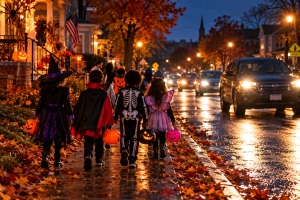
 Halloween has a danger that nobody talks about at costume parties or while sorting through candy. It is not the razor blades in apples, a fear that turned out to be almost entirely mythological. The real danger on Halloween is hiding in plain sight, and it has been documented by decades of research and traffic data. On Halloween night, children are more than twice as likely to be struck and killed by a vehicle than on any other evening of the year.
Let that settle in for a moment. Not slightly more likely. More than twice as likely.
According to data from the American Medical Association drawing on 42 years of National Highway Traffic Safety Administration records, the risk of pedestrian fatalities is 43% higher on Halloween compared to any other night. Children between the ages of 4 and 8 are ten times more likely to be hit by a vehicle on Halloween than on a typical evening. The research found 608 pedestrian deaths over 42 Halloweens studied, representing a consistent, documentable pattern of preventable tragedy.
In Massachusetts specifically, between 2002 and 2022, 57 pedestrians under the age of 18 were struck by cars on Halloween, more than twice the number hit on any other single day of the year, according to AAA Northeast. These are Massachusetts children, on Massachusetts streets, hurt or killed during a night that is supposed to be about fun.
Why Halloween Creates This Danger
The reasons are almost cruelly straightforward. Halloween puts enormous numbers of child pedestrians on the streets at exactly the same time as the evening commute. Between 5 PM and 9 PM, when trick-or-treating is at its peak, foot traffic in residential neighborhoods multiplies dramatically while visibility decreases. The sun sets earlier in late October than at any other major holiday that sends children outdoors. Dark costumes blend into dark streets. Children dart between houses and driveways without looking. Groups of excited kids move unpredictably across roads in ways that drivers do not anticipate.
And then there is the adult factor. November 1st, the day after Halloween, is statistically the deadliest day for adult pedestrians, largely because adults are out late the night before and alcohol is heavily involved in Halloween parties and events. NHTSA estimates that from 2019 to 2023, nearly 200 people were killed in crashes on Halloween night that involved a driver with some level of alcohol in their system. In Worcester, a city with a busy restaurant and nightlife scene and a significant college population, the combination of Halloween festivities and impaired driving creates genuine risk for anyone on foot that night.
Dark Costumes, No Reflective Gear, and What It Means Legally
One of the tactics insurance companies use when a child is struck on Halloween is to argue contributory negligence based on the child’s costume or behavior. A dark costume with no reflective elements, a child who ran into the street without looking, a group that moved unpredictably: these are all things that defense attorneys will point to in an effort to reduce or eliminate a family’s recovery.
Massachusetts law handles this carefully. Children are held to a standard of care appropriate for their age and maturity, not the same standard as an adult pedestrian. A seven-year-old running between houses in an excited group is behaving exactly as seven-year-olds do. Drivers in residential neighborhoods on Halloween night are legally required to anticipate pedestrian activity, drive slowly, and exercise heightened caution. The duty to avoid hitting a child does not disappear because the child was wearing a black witch costume.
A pedestrian accident lawyer in Worcester who has handled child injury cases knows how to push back hard against these blame-shifting arguments and make sure the focus stays where it belongs: on the driver who failed to exercise appropriate care on the most predictable pedestrian-heavy night of the entire year.
What Families Can Do to Reduce Risk This Halloween
Practical safety steps matter. Reflective tape on costumes or bags is genuinely effective and takes thirty seconds to apply. Glow sticks, LED accessories, and flashlights make children dramatically more visible to drivers. Groups should cross streets at corners and crosswalks whenever possible, not mid-block. Adults accompanying younger children should position themselves between the children and the road, not behind the group.
But individual family precautions can only do so much. The systemic problem, which is that drivers do not slow down enough in residential areas on Halloween, is one that legal accountability helps address over time. When a family brings a claim after their child is struck by a negligent driver, it creates consequences that make drivers think twice. It also provides the financial resources families need to cover medical bills, trauma care, and whatever rehabilitation their child requires.
If Your Child Was Struck by a Car in Worcester
If a vehicle struck your child this Halloween or at any other time while they were walking in Worcester, contact a personal injury lawyer in Worcester immediately. Time matters for evidence preservation, and the shock of what your family has been through should not be compounded by trying to navigate an insurance claim alone.
Massachusetts provides strong legal protections for child pedestrian accident victims, and claims involving children who were struck by negligent drivers can include current medical costs, future medical needs, pain and suffering experienced by the child, and in serious cases, compensation for permanent injuries that will affect your child’s life for decades.
Your family did not deserve this. A pedestrian accident lawyer in Worcester can help you make sure someone is held accountable for it.