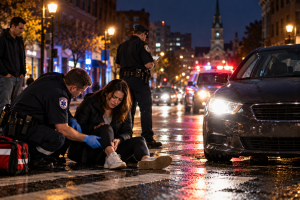
 Walk into any conversation about a pedestrian accident that happened at night in Worcester and you will hear a version of the same defense emerge almost immediately, from other drivers, from bystanders, sometimes from the at-fault driver themselves: “It was dark. They came out of nowhere. There was nothing I could do.” The implication is that nighttime pedestrian accidents are an unfortunate inevitability of darkness, something beyond any driver’s reasonable control.
Massachusetts law does not see it that way. And neither should you if you were hurt walking in Worcester after sunset.
The statistics around nighttime pedestrian accidents in Massachusetts are stark. Published data from the Massachusetts Department of Public Health shows that pedestrian crashes involving darkness account for a disproportionate share of serious and fatal injuries, with the period between 5 PM and 10 PM being particularly dangerous, especially in October and November as daylight shrinks rapidly with the seasonal change. In a recent study of Massachusetts pedestrian fatalities, 88% involved being struck by a motor vehicle, and the majority of those fatal incidents occurred in low-light or dark conditions.
But the prevalence of nighttime accidents does not make them legally unavoidable. It makes them predictable. And predictable hazards that drivers fail to account for are exactly what negligence law exists to address.
The Legal Duty Does Not Have an Off Switch at Sundown
A driver’s duty of care to pedestrians does not diminish when the sun goes down. If anything, Massachusetts law requires drivers to exercise heightened caution when conditions reduce visibility, because reduced visibility creates greater risk of harm to other road users. A driver who travels at the same speed in darkness as they would in full daylight, without adequate headlights, without reduced following distance, and without heightened attention to crosswalks and pedestrian areas, is failing to adapt their driving to the conditions they are operating in. That failure is negligence.
The “they came out of nowhere” defense also has specific legal vulnerabilities that an experienced pedestrian accident lawyer in Worcester will exploit. A pedestrian walking in a crosswalk at a signalized intersection does not “come out of nowhere.” A pedestrian crossing a familiar downtown Worcester street at a marked crossing point does not “come out of nowhere.” A pedestrian walking along the shoulder of a road in an area where pedestrian activity is common and foreseeable does not “come out of nowhere.” What these scenarios actually describe is a driver who was not paying adequate attention to an area where pedestrian presence was foreseeable.
Speeding Amplifies Nighttime Risk and Strengthens Your Claim
There is a physical reality to nighttime driving that creates a specific form of driver negligence that traffic safety researchers call “overdriving your headlights.” Standard headlights illuminate approximately 160 to 250 feet of road ahead. A vehicle traveling at 55 miles per hour covers that distance in under three seconds. At night, on a road without street lighting, a driver going 55 mph who encounters a pedestrian at the edge of their headlight range has essentially no time to react and stop before impact.
Overdriving your headlights, traveling at a speed that does not allow you to stop within the distance your headlights illuminate, is a recognized form of negligent driving. When a driver is exceeding the speed limit in a poorly lit area of Worcester at night, or traveling at the speed limit in conditions that make that speed unsafe, and they strike a pedestrian they claim they could not see, the argument that darkness made the accident unavoidable often collapses under scrutiny. If they had been going slower, they could have stopped in time. They chose not to adjust their speed. That choice is negligence.
Street Lighting Failures and Municipal Responsibility
In some nighttime pedestrian accident cases in Worcester, the inadequacy or failure of street lighting is a contributing factor that creates liability beyond the driver alone. City-maintained streetlights that have been reported as non-functional and not repaired, poorly lit crosswalks in areas with significant pedestrian traffic, and intersections where lighting conditions have been identified as hazardous all raise questions about municipal responsibility that a Worcester personal injury attorney will investigate alongside the driver’s liability.
Claims against the City of Worcester for infrastructure failures that contribute to pedestrian accidents involve the same 30-day written notice requirement discussed in other contexts of municipal claims in Massachusetts. If inadequate street lighting contributed to your accident, this procedural deadline is another reason to get legal counsel immediately.
What Pedestrian Accident Victims Should Document After a Nighttime Crash
If you are able, photograph the scene at or near the time of the accident to capture the actual lighting conditions. A photograph taken at 9 PM showing the absence of functional street lighting, or the inadequacy of existing lighting at the accident location, is far more compelling evidence than a description of dark conditions taken in daylight the next day.
Note the speed limit at the location and your estimate of how fast the vehicle was traveling. Note whether the driver’s headlights were functioning, properly aimed, and adequate for the conditions. Identify any witnesses who were present and willing to provide a statement about what they observed.
Get medical attention immediately and be thorough in describing all of your symptoms to treating physicians. Pedestrian accident injuries are often severe given the physics of a vehicle striking a person with no structural protection, and the full picture of those injuries may not be apparent in the immediate aftermath of the event.
Contact a pedestrian accident lawyer in Worcester as early as possible. Nighttime pedestrian accident cases require prompt evidence preservation and a legal theory that addresses the darkness argument directly and effectively. You were hit because a driver failed to adjust to conditions that required caution. The darkness does not protect them from that responsibility. A Worcester personal injury attorney can make sure the law does not protect them from it either.