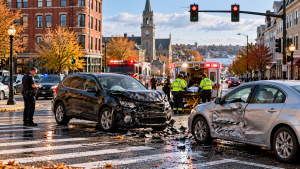
 A few years ago, the Southeastern Regional Planning and Economic Development District took three years of crash reports, 2017 through 2019, and ranked the 100 most dangerous intersections in the region. Then somebody counted where they were. Thirty-one of them are in New Bedford. One city, almost a third of the list.
If you drive here, you probably didn’t need a report to tell you that. Ashley Boulevard at Coggeshall Street came in third, with 91 crashes. Kempton Street at Brownell Avenue, where Route 6 meets Route 140, came in fourth with 88. JFK Highway at Potomska Street and at Elm Street both landed in the top ten. Separately, a MassDOT-based ranking of the costliest crash locations in the whole state put a New Bedford intersection fourth in Massachusetts, with 587 crashes over those same three years.
In fairness, the planning district also said that improvements have been made at many of the intersections on its list, including several in the top ten. Old data isn’t a verdict on today’s roads. But it does matter if you were hurt in a crash here, and not always in the way people assume.
A dangerous intersection is not an excuse
Here’s something that comes up a lot. The other driver, or more often their insurance company, says some version of “that intersection is a mess, accidents happen there all the time.” The implication is that nobody could really be blamed.
It works the other way around. A driver who knows, or should know, that an intersection is crowded, has awkward turn lanes, or gets backed up at rush hour is expected to drive accordingly. Slow down. Leave room. Watch for the car that’s going to jump the light. Knowing the place is difficult raises the level of attention a reasonable driver brings to it. It doesn’t lower it.
Massachusetts does insurance differently, and it trips people up
Massachusetts is a no-fault state for the first layer of coverage. Personal injury protection, usually called PIP, pays up to $8,000 of your medical bills and some lost wages after a crash no matter who caused it. You don’t have to prove anything to get it. You just file with your own policy.
That first $8,000 is where a lot of people stop thinking. They get a few weeks of physical therapy, the PIP money runs out, and they assume the claim is over. It isn’t. If the other driver was at fault, you can go after them for the rest, including pain and suffering, but there’s a threshold. In general you need reasonable medical expenses above $2,000, or a more serious injury such as a broken bone, to bring that kind of claim. Most real crash injuries clear that bar quickly. Still, it’s one of those details a New Bedford personal injury attorney will sort out in the first conversation, because getting the order of operations wrong costs people money.
Who else might be responsible
Most of the time the answer is the driver who hit you, and that driver’s insurer. I’d rather say that plainly than dangle bigger possibilities.
Occasionally the intersection itself is part of the story. A signal that was malfunctioning, a faded stop line, a sightline blocked by something the city or a property owner put there. Claims like that are harder. Public agencies have special notice rules and damage limits, and the deadline for written notice on road defects can be as short as 30 days. So if you think the road itself played a role, say so early. Don’t assume it can wait until you feel better.
The evidence on a busy road disappears quickly
JFK Highway and the Route 6 corridor are lined with gas stations, banks, and shops, and plenty of them have cameras pointed at the street. That footage can show the light phase, the speed, who stopped and who didn’t. It also gets recorded over, often within a few days, sometimes sooner.
The witnesses are the other problem. At an intersection like these, the people who saw your crash were mostly strangers on their way somewhere. They gave a name to the officer if they stopped at all, and they get harder to reach every week.
Here’s what helps, if you’re able to do any of it:
Photograph the intersection from each approach, not just the damaged cars. Note which businesses have cameras and write down their names. Get your own vehicle’s repair estimate and don’t authorize a total loss settlement before you’ve talked to someone. If your car has a camera or you’ve got a dash cam, save the footage immediately. And ask the police for the report number before you leave the scene.
Fall makes these roads worse
October and November are hard on New Bedford drivers. Sunset moves earlier every week, and when the clocks fall back in early November the evening commute shifts into full dark almost overnight. Low sun glare is brutal on the east-west stretches. Rain and wet leaves lengthen stopping distances at exactly the places where people already follow too closely. Add the early holiday shopping traffic around the commercial strips and you’ve got more cars in less light with less patience.
If you’re hurt in a crash this fall, the clock on your claim starts that day. Massachusetts generally gives you three years to file a lawsuit, but the practical work (evidence, medical records, insurer deadlines) can’t wait that long.
Talking to a lawyer costs nothing
You don’t need to know whether your case is big or small before you call. Most personal injury lawyers in New Bedford offer a free consultation and take cases on contingency, meaning no fee unless you recover money. Ask about PIP, ask about the $2,000 threshold, ask what the insurance company is likely to offer and why it’s probably too low. You’ll learn more in twenty minutes than you will from a week of reading adjuster emails.