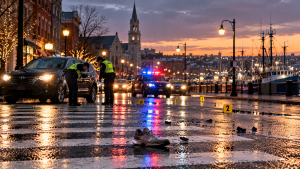
 In the first two days of 2026, two people on foot died on New Bedford streets.
The first happened just after midnight on New Year’s Day on Acushnet Avenue. A 33-year-old woman was leaving a church gathering with her family and crossing the road when an SUV hit her and kept going. The next evening, around five o’clock, a man was struck and killed on Route 6 near Pleasant Street. Police later charged a teenage driver in the Acushnet Avenue case, which is more than families get in a lot of hit-and-runs.
Those two crashes got the headlines. They weren’t the whole picture. The city has had pedestrians hurt on its busiest streets for years, and the numbers elsewhere in Massachusetts tell a similar story.
What the statewide numbers say
WalkMassachusetts, which tracks pedestrian deaths using MassDOT crash data, reported that 354 people died in traffic crashes across the state in 2025. At least 76 of them were on foot, a little over one in five. Nearly 70 percent of those fatal pedestrian crashes happened in the dark. And about 17 percent involved a driver who left the scene.
That last number is the one families in this situation fixate on, understandably. Somebody hit your husband, your mother, your daughter, and drove away. There’s anger, and underneath it, a very practical fear. If nobody’s found, who pays?
You may not need to find the driver to get paid
This is the part nobody explains at the hospital.
Massachusetts requires every registered car to carry personal injury protection, and PIP follows the injured person, not just the driver. A pedestrian hit by a car in Massachusetts can usually claim PIP benefits for medical bills and lost wages, up to $8,000. If the car that hit you can’t be identified, you generally turn to your own auto policy, or to a policy held by a relative who lives in your household. In a city where multigenerational homes are common, that second option matters. You may be covered under a policy you’ve never thought about, because a parent, a sibling, or a spouse owns the car.
Beyond PIP, Massachusetts auto policies include uninsured motorist coverage, and that can apply when the driver is unknown. Coverage rules and notice deadlines vary by policy, so don’t wait to find out. Tell the police, tell the insurer, and get someone to read the policy language with you.
None of this makes up for what happened. It does mean that “they never caught the driver” is not the same as “there’s nothing we can do.”
The first days matter more than people expect
Hit-and-run cases are won on what gets collected early. Police do their own work, but they’re stretched, and what they focus on is the criminal case. A civil claim needs things they may not chase.
Cameras are the big one. Acushnet Avenue and Route 6 are lined with storefronts, and many of them record the street. Footage can show a vehicle’s size, color, headlight shape, even a partial plate. It’s also overwritten on a schedule, sometimes within days. Debris at the scene (a piece of a mirror, a chunk of bumper) can identify a make and model. Witnesses who saw a vehicle speed away may remember it clearly for a week and vaguely after that.
If you’re the injured person and you can’t do this yourself, a family member can. Walk the block. Look at the buildings and the lampposts for cameras. Write down the business names, and then have a lawyer send preservation requests. This is exactly the kind of leg work a pedestrian accident lawyer in New Bedford does in the first week.
Fall puts more people in harm’s way
It’s getting dark earlier every day. When the clocks go back in early November, the evening walk home from work, from the bus, from a late shift, happens in full darkness. New Bedford is a working city. A lot of people walk to jobs that start before sunrise or end after dark. Crosswalks that feel fine at noon feel different at 5:30 with headlights in your eyes.
Drivers know this too, or should. A driver is expected to adjust to darkness and rain, not just to the posted limit. Going the speed limit in conditions that don’t allow you to stop in time isn’t a defense. It’s often the very mistake.
If the driver is found
Then the case looks more like a standard pedestrian claim, with some extra layers. The driver’s insurance, if there is any, becomes the main source of compensation. If the driver was a minor, the parents’ policy and potentially the parents’ own responsibility may come into play, depending on whose vehicle it was and what they knew. If the driver was uninsured, your own uninsured motorist coverage steps in.
Massachusetts also uses a comparative negligence rule. Insurers will look for any reason to assign you a share of the blame: you were wearing dark clothes, you weren’t in a crosswalk, you were looking at your phone. Being partly at fault doesn’t automatically end a claim here. It does reduce it, and if you’re found more than 50 percent responsible you can lose it entirely. That’s one reason these cases shouldn’t be handled over the phone with an adjuster.
When someone you love didn’t survive
A wrongful death claim is separate from any criminal case, and it can go forward whether or not the driver is prosecuted. Funeral costs, lost income, and the loss of a person’s presence in a family are all recognized. The deadline is generally three years from the date of death, but the evidence problems described above don’t wait three years. If this is where you are, take whatever time you need to grieve. Just ask someone to start the preservation work now.
Where to start
Call a personal injury lawyer in New Bedford for a free consultation. You don’t need a police report number or a settled story. Bring what you have, even if it’s a handful of photographs and a name from the hospital. The first conversation is mostly about what coverage exists and what needs to happen this week.