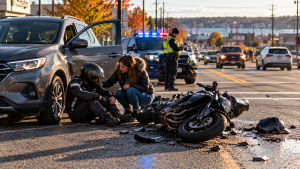
 Late October, clear afternoon, cold enough that you can see your breath at the stoplight but warm enough once you’re moving. You roll out of New Bedford on Route 6 heading toward Fairhaven or Mattapoisett, maybe all the way to the Cape. For a lot of riders around here, this is the last good day before the bike goes under a cover.
It’s also a stretch of road with a lot of driveways. And that matters, because the way most riders get hurt on roads like this isn’t dramatic. It’s a car turning left across their path.
What happens in a left-turn crash
You’ve got a green light or a clear road. A driver coming the other way, or pulling out of a gas station or a plaza, looks toward you, and still doesn’t register you. Then they go. You have about a second to react, and usually nowhere to go.
The driver’s explanation is almost always the same. “I never saw him.” And often they’re being honest. Drivers are scanning for cars and trucks, and a motorcycle’s narrow profile can slip through that scan. Safety researchers have a name for it, looked-but-failed-to-see. A landmark University of Southern California study, the Hurt Report from 1981, found that in crashes between a motorcycle and another vehicle, the other driver violated the rider’s right of way in roughly two-thirds of cases. It’s an old study. It’s also still the one safety groups cite, and it matches what riders will tell you from experience.
Honest or not, “I didn’t see you” is not a defense. Drivers have a duty to look carefully before they cross a lane of traffic. Failing to see something that was there to be seen is negligence.
Why the Route 6 corridor deserves extra attention
The Southeastern Regional Planning and Economic Development District’s list of the region’s most dangerous intersections included a number of locations along Route 6 and its junctions in New Bedford, among them Kempton Street at Brownell Avenue, which ranked fourth with 88 crashes in the three years studied. Strips with lots of curb cuts and turn lanes are exactly where left-turn conflicts come up.
This isn’t to say you shouldn’t ride there. It does mean you should ride like every driver waiting to turn hasn’t seen you, because a lot of them haven’t. Lane position, brake lights tapped before intersections, and a little extra gap at driveways all help. They don’t change who’s at fault if a driver pulls out in front of you, but they could change whether you walk away.
The numbers behind the risk
The National Highway Traffic Safety Administration has reported that, mile for mile, motorcyclists are about 28 times more likely to die in a crash than people in passenger cars. Even a low-speed collision can mean a broken leg, a shattered wrist, a spinal injury, or a traumatic brain injury. Which is why the medical bills in these cases tend to be big, and why insurers fight them so hard.
Where Massachusetts treats riders differently
Here’s a detail most people don’t hear until they’re in the middle of a claim. In Massachusetts, drivers of cars have personal injury protection, the no-fault coverage that pays the first $8,000 of medical bills regardless of fault. Motorcyclists generally aren’t part of that system. That changes how your early bills get paid. Your own health insurance, or any medical payments coverage on your motorcycle policy, may become the first line, and the claim against the at-fault driver carries more of the weight.
The details depend on your policy and your situation, so ask a lawyer early. It’s the kind of thing that’s easy to get wrong and expensive when you do.
What the other side will say
Riders often tell the same story about insurance adjusters. The first questions aren’t about the driver who turned. They’re about you. How fast were you going? Were you lane splitting? Did you have your lights on? How much experience do you have? The goal is to move some of the blame onto the rider, because under Massachusetts comparative negligence rules, any share assigned to you reduces your recovery, and more than 50 percent can end it altogether.
The best answer is evidence. Helmet cam or dash cam video. Camera footage from nearby businesses. The vehicle’s own event data recorder, which often logs speed and braking, if someone moves quickly to preserve it. Skid marks and point of impact documented before they’re gone. Witnesses who were behind you or at the stoplight. A lawyer can often get that evidence in hand in the first couple of weeks, when it still exists.
Late season hazards
Fall riding has its own issues, and they overlap with the left-turn risk. Sand and salt residue collects at the edges of lanes. Wet leaves reduce traction in corners and on entrance ramps. Tires don’t warm up as quickly in cold air. And the light changes. Low sun in your eyes or the driver’s eyes can make a rider nearly invisible, and when the clocks go back in early November, dusk arrives in the middle of the commute.
Wear bright or reflective gear. Run your high beam in the daytime if the law and your bike allow it. And a DOT-approved helmet isn’t optional here anyway, since Massachusetts requires one for every rider and passenger.
If you’ve been hurt
Get checked out, even if you feel mostly okay. Adrenaline lies. Take photos of your injuries, your gear, the scene, and the other vehicle. Don’t repair the bike or toss the helmet or jacket until your lawyer has seen them. Keep the damaged gear as is.
Then call a personal injury lawyer in New Bedford who has handled motorcycle cases. A New Bedford personal injury attorney will know the roads, the usual insurers, and the arguments that get thrown at riders. The first conversation is free, and it’s probably the most useful hour you’ll spend in the weeks after a crash.