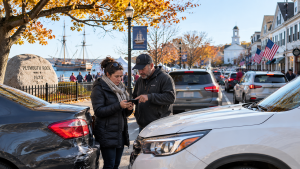
 Plymouth calls itself America’s Hometown, and on the Saturday before Thanksgiving it acts like it. There’s a parade, a historic village in Brewster Gardens, reenactors on the waterfront, and a line of people waiting to look at a rock. The town’s own tourism office says Plymouth Rock alone draws more than a million visitors a year, and the Thanksgiving weekend is one of the busiest stretches on the calendar. When the celebration’s organizers made projections back in 2018, they were expecting about 150,000 visitors over the three days.
That’s a lot of cars for a downtown that was laid out long before anyone owned one. The town’s visitor guidance doesn’t hide it. Expect heavy traffic and limited parking, it says, and take public transit if you can.
Most people don’t. They drive, they circle, and they get frustrated. If you were hurt in a crash around Plymouth that weekend, or any weekend when the town is full, there are a few things about these cases that are worth knowing.
Where the crashes tend to come from
Three roads do most of the work. Route 3 carries Boston traffic south and Cape traffic north, and the stretch through Plymouth is busy all year. Route 44 brings people in from the west. Route 3A, which becomes Court Street and runs right through the middle of town, is where everyone ends up.
The problems stack up in predictable ways. Traffic that moves fast on the highway meets traffic that stops dead near the exits. Drivers following GPS directions make late lane changes. People looking for a parking space drift across the center line, brake suddenly at a garage entrance, or pull out without looking. And a lot of those drivers have never been to Plymouth before.
Rear-end crashes in stop-and-go traffic are the classic result. They don’t sound serious. The cars are barely moving, the damage might be a cracked bumper. But neck and back injuries from a low-speed rear-end hit are real, and they have a way of showing up a day or two later, once the adrenaline wears off.
The other driver is probably going home
This is the part that’s specific to a tourist town. Say a car with New Jersey plates backs into you outside a parking garage on a Saturday afternoon. You’re hurt. The other driver is apologetic. By Sunday they’re two hundred miles away, and you’re trying to find out whether anyone is going to pay for your emergency room visit.
It’s not as hopeless as it sounds. A crash that happens in Massachusetts can be handled under Massachusetts law, and the state has a process for serving a lawsuit on a non-resident driver involved in a crash here. The insurance companies are almost always national, so a claim gets handled by phone and email no matter where the driver lives. But the practical problem is evidence and information. People who live elsewhere are easier to lose track of, and witnesses scatter fast on a crowded weekend.
If you’re able to, collect all of this at the scene:
The other driver’s name, phone number, license plate (and state), and a photo of their insurance card. A photo of their license, if they’ll allow it. Names and numbers for any witnesses, including the person who walked over and said, “I saw the whole thing.” The police report number. And photos of both cars, the road, the signs, and anything blocking the sightline.
If you can’t do any of that because you’re in an ambulance, a family member can often go back and do some of it. Do it soon.
Parking lot crashes are still crashes
Some of the worst arguments about fault happen in parking lots and garages. Nobody has the right of way in a clear way, everyone’s moving slowly, and each driver thinks the other one should have waited. Insurers love these situations, because it’s easy to suggest that you shared the blame.
Under Massachusetts comparative negligence rules, you can still recover if you were partly at fault, as long as you were not more than 50 percent responsible. Your recovery is reduced by your share. So these disputes aren’t academic. Ten percentage points of blame can be real money, and an insurer’s first move is often to push more of it onto you than you deserve.
Cold weather adds a risk of its own
Late November on the South Shore means frost, and sometimes more. Local news has reported standstills and spin-outs on Route 3 and Route 44 when roads froze over, and the first cold snap of the year catches plenty of drivers off guard. Dark falls early too. By the time the parade ends, many people are driving home in the dark on roads they don’t know.
If road conditions played a part in your crash, tell your lawyer. The other driver’s duty is to drive for the conditions, not the speed limit, and a driver who went too fast on a frosty road can be responsible even if there was ice involved.
What to do next
Get checked out, even if you feel fine. Keep every record. Don’t give a recorded statement to the other driver’s insurer before you’ve had advice, and don’t accept a quick settlement while you’re still treating. If your car is being repaired or totaled, take photographs first.
A personal injury lawyer in Plymouth can handle the part that’s hard from a distance, which is dealing with an insurer in another state, preserving evidence before it’s gone, and figuring out how Massachusetts’s no-fault rules and your own coverage fit together. Whether you live five minutes from the harbor or five hours away, the first consultation is free, and most Plymouth personal injury attorneys only get paid if you do.