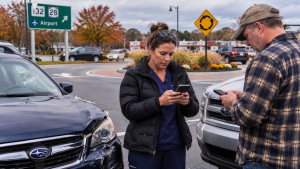
 Let’s make up a driver. Call her Dana. She works at a dental office, drives a ten year old Subaru, and on a gray Thursday afternoon in late October she is heading home on Route 132 toward the Airport Rotary. Someone coming off Route 28 doesn’t slow down enough, tries to merge into the circle, and clips the front corner of her car. Nobody screams. Nobody bleeds. Both drivers pull over by the curb and say the usual things.
Dana is fine, she thinks. This is the moment where most of these cases quietly start going wrong, so it is worth walking through what happens next. Dana isn’t real, but her next three weeks are very familiar to anyone who handles collision claims on the Cape.
Day one: the fender bender that doesn’t feel like one
The other driver apologizes, which feels nice. Dana skips calling the police because the dent looks small and traffic behind them is honking. Two days later the other driver’s story has changed. Now Dana “came out of nowhere.” Without a police report, there is nothing on paper to say otherwise.
If you take one thing from this article, take this: call the police, even for a small hit. In a place like Hyannis, with its mall traffic, ferry traffic and constant turning, a report is the cheapest piece of evidence you will ever get. It records the date, the location and the names, and sometimes the officer’s note about who failed to yield.
Photos matter too. Dana should photograph the lane markings, the sign she passed, and the other car’s plate. Rotaries are famous for fights over who was where, and a picture of the cars’ positions ends many of those fights.
Day three: the neck that won’t turn
By Saturday morning Dana can barely look over her left shoulder. This is ordinary. Soft tissue injuries often take a day or two to show up, because the body is flooded with adrenaline at first and then the muscles tighten overnight.
She goes to urgent care. That visit is more important than it seems. It ties the pain to the crash, and it starts the paper trail a claim will lean on later. If she had waited three weeks to see anyone, the other side’s insurer would be happy to suggest she hurt herself raking leaves.
Week one: who pays first
Massachusetts runs on a no-fault basis for the first slice of medical costs. Dana’s own policy carries Personal Injury Protection, usually up to $8,000, and it pays for treatment and some lost pay no matter who caused the crash. She doesn’t have to wait for anyone to admit fault to get her first bills handled.
The catch is that PIP is only the beginning. If she wants to pursue the other driver for pain and suffering, the state sets a threshold. Generally her reasonable medical bills have to top $2,000, or she needs a qualifying injury such as a fracture. Neck pain plus imaging plus a month of physical therapy gets many people over that line sooner than they expect.
Week two: the phone call
This is where it gets slippery. The other driver’s insurance company calls. The adjuster is polite and a little cheerful. They ask whether Dana is feeling better and whether she would mind giving a quick recorded statement, just so they can close things out.
She isn’t obligated to do that. Saying “I’m doing okay, thanks” can be quoted later as proof she wasn’t hurt. A question like “were you in a rush?” can be used to hang part of the blame on her, and in Massachusetts that matters a great deal. If an insurer or jury decides she was more than half responsible, she gets nothing. If she was 20 percent responsible, her recovery drops by that amount. Fault percentages are worth real money here.
A personal injury lawyer in Hyannis will usually take that call out of your hands. Instead of Dana improvising answers, her attorney sends the records and does the talking.
Week three: why the location itself becomes evidence
Here’s something Dana wouldn’t think of on her own. The place where she was hit has a history. Planners and the Cape Cod Commission have looked closely at the Airport Rotary, the nearby stretch of Route 132, and other busy spots around Hyannis, and local news has regularly reported collisions in these areas. That does not make every crash someone else’s fault. But it can help explain why drivers get confused there, and it supports the argument that a driver entering the circle had to be extra careful.
Business cameras are the other big factor. A store near the rotary may have footage showing the entire merge. Many systems record over themselves in a couple of weeks. An attorney who moves fast can ask for it before it is gone.
What Dana’s story teaches
None of this required anything dramatic. No courtroom, no confrontation. Just a normal crash, a sore neck and a friendly phone call. The decisions that shaped her claim all happened in the first month: calling the police, seeing a doctor, taking pictures, and not talking to the adjuster alone.
Massachusetts gives most injured people three years to file a lawsuit, but waiting that long to get advice is a bad idea. If you’ve been in a crash near the rotary, on Route 28, or along Route 132, speak with a Hyannis personal injury attorney early. The first consultation is free, and it’s a lot easier to build a strong claim from the start than to repair a weak one later.