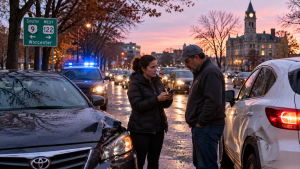
 The clocks went back on Sunday, November 1, and if you drove home on Monday afternoon, you probably felt it. Sunset now arrives right around the time many people are leaving work. The same commute you made in daylight last week is suddenly a dusk or after-dark drive, and your eyes, your windshield, and your patience all have to catch up.
This isn’t just a feeling. A Worcester car accident lawyer sees the paperwork that follows, and the pattern shows up in published crash data too.
What AAA found about the weeks after the time change
AAA Northeast analyzed Massachusetts crash data for the 5 p.m. hour from 2016 through 2020. Comparing the four weeks after the clocks changed with the four weeks before, it found that crashes at that hour rose 53 percent, from an average of 27 per day to 42 per day. The same analysis found the chance of a pedestrian being struck at that hour rose 274 percent.
The national picture in that same release was starker. Looking at the 5 p.m. hour from 2010 through 2019, AAA reported that fatal car crashes in the first week after the time change rose 73 percent, from an average of 26.2 to 45.3 per week.
One caution: these are AAA’s own analyses, and the release doesn’t name the underlying dataset. They’re best read as a strong warning sign rather than a precise forecast for any single Worcester street.
Why the 5 p.m. hour gets so risky
Think about what’s stacked into that one hour. It’s rush hour, so traffic is heavy and drivers are in a hurry. It’s dusk, which is a notoriously hard time to judge distance and speed. And the body clock hasn’t adjusted yet.
That last part matters. The same AAA release cites the AAA Foundation’s 2020 Traffic Safety Culture Index, in which 17 percent of motorists admitted to driving while so tired they had trouble keeping their eyes open at least once in the previous 30 days. AAA also notes that headlights can deteriorate even after three years, and that a 60-year-old needs about three times more light to see the roadway than a 20-year-old does.
Put it together and you can see why a crowded stretch like Park Avenue or Route 9 feels different in November than it did in October.
How fault gets argued when it’s dark
After a collision, everyone has a story, and “I couldn’t see” is a very common one. It can be said by the driver who hit you, or hinted at by an insurer about you.
Massachusetts uses a comparative negligence rule. Under G.L. c. 231, section 85, being partly at fault doesn’t automatically bar your claim, as long as your negligence wasn’t greater than the total negligence of the person you’re claiming against. Your damages are reduced in proportion to your share. So if an adjuster can move a few percentage points your way by pointing to a burned-out taillight or a dark jacket, that matters.
A Worcester car accident lawyer will look at the details that tend to decide those arguments: whether headlights were on, how far ahead each driver could realistically see, what the streetlights were doing, and how quickly each driver reacted.
What to do if you’re hit at dusk or after dark
Get to a safe spot if you can. A dark roadside is a second hazard, so turn on your hazards and, if you’re able, stand well off the road.
Take photos right away, and take more than you think you need. Capture the lighting conditions as they actually were, because the scene will look different in daylight a week later. Photograph the position of both cars, the damage, nearby streetlights and any signs. If your car has a dash camera, save the footage before it records over itself.
Call the police and get a report. Ask any witnesses for names and phone numbers before they leave.
Then see a doctor, even if you feel okay. Adrenaline can hide pain for a day or two, and a gap between the crash and your first visit is something an insurer may point to later.
A quick pre-drive check
Some of this is within your control, and none of it is complicated. Before the evening commute, wipe the inside of the windshield, where a film builds up and scatters headlight glare. Make sure your headlights and taillights are working and aimed properly, and replace foggy lenses if they look dull. Leave a little more room behind the car ahead than you would in daylight, because judging distance at dusk is harder. None of that makes a crash your fault if someone else hits you, but it does give you fewer things to explain to an adjuster afterward.
Before you talk to the other insurer
The other driver’s insurance company may call quickly and sound friendly. You can say you’ll get back to them. Recorded statements taken early, before you know the full extent of your injuries, can be used against you later.
If you’ve been hurt in a crash during these shorter days, a conversation with a Worcester car accident lawyer can help you understand where you stand before you say anything on the record. Massachusetts has strict filing deadlines for injury claims, so don’t wait longer than you have to to ask about yours.