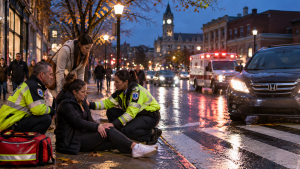
 There’s a particular kind of November walk that a lot of people in Worcester know well. You leave work, a class or a shift at the hospital, and it’s already dark. The crosswalk is a few hundred feet away, the street is busy, and you’re deciding whether to trust that every driver sees you.
A Worcester pedestrian accident lawyer hears what happens when they don’t. This article pulls together what the published numbers say, what the city itself has said about safety, and what Massachusetts law requires of drivers.
What the national numbers say about darkness
The National Highway Traffic Safety Administration’s 2023 pedestrian fact sheet reports that 7,314 pedestrians were killed in U.S. traffic crashes that year. Of those deaths, 77 percent happened in the dark, compared with 19 percent in daylight. NHTSA breaks the numbers down by season, too. In the fall, which it defines as September through November, the largest share of pedestrian deaths, 32 percent, occurred between 6 and 8:59 p.m.
Those are national figures, not Worcester-only ones. But the hours line up with how a lot of people actually walk in November.
What Worcester has said about its own streets
In August 2024, city leaders declared a “Road Safety and Traffic Violence Crisis” after several pedestrian crashes involving young people. A city spokesperson cited more than 2,800 crashes to that point in the year, 51 that seriously injured or killed someone, and 90 that involved pedestrians or cyclists, according to Boston 25 News.
The city’s 2026 Vision Zero annual report adds more. It cites an executive order stating that 45 people died and 461 were seriously injured in Worcester traffic crashes from 2019 through 2023. It also says that in 2025, pedestrians and bicyclists each had more serious or fatal injuries than at any point in the past decade, and that people outside of cars account for 40 percent of fatal and serious injuries while being involved in only 4 percent of total crashes.
Read that last number again. Walking or biking is a small share of crashes and a big share of the worst outcomes.
What the law says drivers must do
Under G.L. c. 89, section 11, where there’s no working traffic signal, a driver must yield the right of way, “slowing down or stopping if need be,” to a pedestrian in a marked crosswalk. The law also says a driver may not pass another vehicle that has stopped at a marked crosswalk. The version quoted here is from 2012, so a lawyer should confirm the current wording for your case.
Pedestrians have duties too. If an insurer claims you crossed outside a crosswalk or stepped out suddenly, Massachusetts’ comparative negligence rule in c. 231, section 85 comes into play. You can still recover if your negligence wasn’t greater than the total negligence of the party you’re claiming against, but your damages are reduced by your share. That’s why a precise account of where you were and what the lighting was like matters so much.
Evidence that fades fast
After a nighttime crash, the best evidence is often temporary. Store and building cameras overwrite their footage. Witnesses walk away. Streetlights get fixed. If you can, or if someone with you can, take photos of the crosswalk, the signals, the lighting and the vehicle that hit you. Write down the plate number if the driver stayed or left.
Then get checked by a doctor. Pedestrian injuries can involve the hips, legs, shoulders and head, and some don’t show up until the next day.
Making it harder for an insurer to blame you
This part isn’t about fault. It’s about not handing anyone an excuse. Wearing light or reflective clothing, crossing where there’s a marked crosswalk and lighting, and putting your phone away at the curb all help. They can’t guarantee safety, because a driver who isn’t paying attention can hit anyone. But they do make it harder for the other side to argue that you made yourself invisible.
For parents and anyone walking with kids
Early dark hits families too. Kids walking home from practice, a bus stop or a friend’s house are doing exactly what they’ve always done, just in much less light. It helps to talk through the route, pick crossings that are well lit, and give them something reflective to wear or clip to a backpack. Remind them to make eye contact with a driver before stepping into the street rather than assuming they’ve been seen. And if a child is ever struck, get medical care first and then write down everything you can about the location, the lighting and the vehicle while it’s fresh.
Getting advice
If you’ve been struck while walking in Worcester, a Worcester pedestrian accident lawyer can help figure out which insurance policies apply, preserve the evidence and deal with the adjuster. Talking early, before you accept an offer or sign anything, is almost always better than talking late.