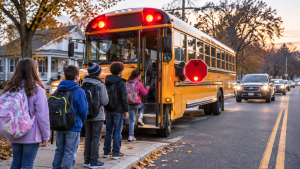
 Walk through a school day from the bus’s point of view and you can see where things go wrong. It’s 6:45 in the morning, the sky is barely light, and a line of kids is waiting at a corner. A driver coming the other way is thinking about work. A driver behind the bus is thinking about being late. The bus’s red lights start to flash, and everyone has about two seconds to decide what that means.
A Fall River school bus accident lawyer sees what happens when the wrong decision gets made. Here’s a timeline of the day and what the published information says about each part of it.
6:45 a.m.: the stop
The Massachusetts RMV’s September 2026 school bus reminder, published on Mass.gov, lays out the rule plainly. Drivers approaching a school bus with flashing red lights have to stop and stay stopped until the lights go off and the stop-sign arm folds back in, unless a police officer directs otherwise. Flashing yellow lights are the cue to slow down and be ready. Traffic in both directions generally has to stop, with one exception: when the road is a divided highway separated by a physical barrier, drivers heading the opposite way don’t have to.
The same notice says drivers traveling behind a bus must keep at least 100 feet back, and that failing to stop for a school bus carries a minimum fine of $250 for a first offense, with higher fines and possible license revocation for repeat offenses.
What the national data says about who gets hurt
The NHTSA fact sheet School-Transportation-Related Traffic Crashes: 2014-2023 Data looked at fatal crashes only. Over those ten years, 1,079 people died in 971 fatal crashes, about 108 a year. Seventy percent of the people who died, 755, were occupants of other vehicles. Another 10 percent were in the school vehicle itself, including 48 drivers and 65 passengers. Pedestrians made up 16 percent, 171 people, and 121 of them were struck by school vehicles.
The document also noted that 209 of the deaths, 19 percent, were school-age children. It found more school-age pedestrians were killed between 7 and 7:59 a.m. and between 3 and 3:59 p.m. than at any other time of day.
Read that carefully. These are deaths, not injuries, and they’re national totals. But they show a point that surprises many people: most of those who died were in other vehicles, not on the bus, and the hours around morning pickup and afternoon drop-off stand out for child pedestrians.
3:00 p.m.: the other end of the day
Afternoon drop-off brings its own risks. Kids step off a bus with energy, cross in front of it, or run for a dropped hat. Drivers who had no reason to expect children may be coming around a curve. And in late fall, dusk starts early, so the afternoon light is changing quickly.
If a child is hurt
Medical care comes first. Children can’t always describe symptoms, so a thorough exam matters even when an injury looks minor. After that, a few things help:
- Write down the exact time, place and which bus or vehicle was involved.
- Photograph the scene, the road, any signs or signals, and visible injuries.
- Get the names of other adults who saw it, including other parents and the bus driver.
- Ask the school or bus company for a copy of any incident report, and keep a record of who you spoke with and when.
- Keep medical records and bills in one place.
Try to avoid pressing a child for a detailed replay. A short account in their own words, written down soon, is more useful than a rehearsed one.
Who may be responsible
It depends on what happened. If a driver passed a stopped bus, that driver is the focus. If the problem involved the bus operator, a stop design or a district decision, other parties may come into view. When a public school or public bus service is involved, claims against public bodies can come with their own procedures and deadlines, so it’s worth asking quickly instead of waiting to see how recovery goes.
The weeks after an incident
Some effects of a school bus or bus stop crash show up slowly. A child may seem fine for a few days and then complain of headaches, trouble sleeping or fear of riding the bus. Keep a short log of what you notice, including missed school, changes in mood and any appointments. If the school offers counseling or a plan for getting to class, ask for it in writing. These records help a doctor understand what’s happening, and they give a lawyer a fuller picture of how the incident has affected your child and your family.
Talking to insurers
Adjusters may call parents within days. It’s fine to take time before giving statements, especially while the child is still being treated. You don’t have to explain the entire incident on the first call.
If your child was hurt at a bus stop or in a school bus crash, a Fall River school bus accident lawyer can help you understand the rules that apply, preserve the records that tend to disappear and talk to the insurers on your behalf.