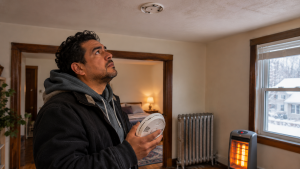
 Here is a week in the life of a tenant who doesn’t exist but easily could. Call him Marcos. He rents the second floor of an older two-family house in Fall River, and the first real cold snap of the year is on its way. The week is invented. The kinds of problems in it are the ones a Fall River landlord negligence lawyer hears about every winter.
Monday: the boiler comes on
The temperature drops overnight and the heat clanks to life around 6 a.m. There’s a faint smell Marcos can’t quite place, a mix of dust and something metallic. It fades after an hour, and he doesn’t think about it again. That’s normal for the first heating day of the season, and it’s also exactly the sort of small detail that matters if the same smell returns on Wednesday and stronger.
The useful habit here is to jot down the date and what he noticed. It takes ten seconds.
Tuesday: the alarm that chirps
Marcos has a smoke alarm in the hall that has been chirping on and off for weeks. Tonight he pulls it down, sets it on a shelf and tells himself he’ll buy a battery later. Nothing bad happens, but something has changed: the one device protecting the hallway outside his bedroom is no longer on the ceiling.
Massachusetts has fairly detailed expectations for where alarms belong. According to the state’s smoke and carbon monoxide alarm guide, smoke alarms are supposed to cover each floor, every sleeping area and the hallways and stairways in between, including the bottom of cellar stairs. Carbon monoxide alarms are meant for every level, including finished basements and attics, and for the area within ten feet of bedroom doors. Marcos’s hall alarm is part of that picture, and so is the question of whether anyone told his landlord it was failing.
Wednesday: the smell comes back
The metallic smell returns, stronger, and Marcos gets a mild headache. He opens a window. He also remembers that he has never seen a carbon monoxide alarm in the apartment.
That matters because Massachusetts treats carbon monoxide differently from ordinary fire hazards. The state’s overview of carbon monoxide detector law points to G.L. c. 148, section 26F1/2, known as Nicole’s Law, which calls for detectors in most residential buildings. The fire services guide adds that landlords must install and maintain carbon monoxide alarms in each rental unit that has a source of the gas. In bigger buildings where individual apartments have no source, it says detection near the furnace, boiler room or garage can stand in.
If you ever have symptoms and suspect carbon monoxide, leaving the building and getting help matters far more than any evidence. Medical care comes first.
Thursday: putting it in writing
Marcos finally texts his landlord. His message is vague: “Heat is weird, can someone look?” A better message would name the smell, the dates, the missing alarm and the removed smoke detector, and it would ask for a reply by a certain day. Short, specific and dated messages are the kind that hold up later. He should also attach a photo of the ceiling where the alarm used to be and the corner of the room with no alarm at all.
He should keep copies somewhere outside the apartment too, such as an email folder, so the record survives whatever happens to the phone or the unit.
Friday: the space heater
The landlord hasn’t answered, the apartment is chilly, and Marcos plugs in a portable heater he found in a closet. It’s a very human decision, and it’s also the point where a landlord’s lawyer will later ask when the original problem began and what the tenant did in response. That’s why the Thursday message matters. The sequence of events, from the first complaint to the workaround, tells a clear story only if it’s written down.
Saturday and Sunday: what a lawyer would look at
Suppose something went wrong over the weekend. A Fall River landlord negligence lawyer wouldn’t start with a conclusion. A missing or disabled alarm doesn’t automatically make a landlord liable for an injury. The questions would be what caused the problem, whether a working alarm would have changed the outcome, who was responsible for maintaining it and what the tenant had reported and when.
It’s also worth being clear about what this article is. It summarizes what the state’s guides say about alarms. It isn’t a legal conclusion about any building, and the type and age of a property can change the requirements.
What Marcos should save
- The removed alarm, any damaged equipment and repair paperwork.
- Photos of the units, stairwells and heating equipment as they were.
- Every message about heat, smells, leaks or alarms.
- A fire department report, if the department responded, which he can ask how to obtain.
The takeaway
Nothing in Marcos’s week was dramatic, and that’s the point. The facts that matter most in these cases are small, ordinary and easy to lose. If you were hurt in a rental because of a heating or alarm problem, a Fall River landlord negligence lawyer can look at what the landlord knew, what the records show and what claims may be available, while the physical evidence still exists.