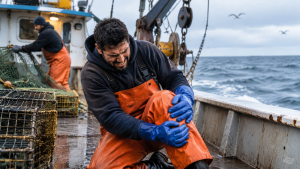
 Picture a deckhand we will call Mateo. He is 31, works on a fishing boat out of New Bedford, and on the third day of a late fall trip a wave lifts the deck while he is handling gear. His knee twists against the rail. The captain tells him to tape it up and keep working, because the boat is a long way from shore and the trip is not over. Mateo is not a real person, but the situation will sound familiar to plenty of people in the fleet. It also raises the question every injured crew member asks sooner or later: what happens now, and who pays? Answering that is the job of a New Bedford commercial fishing accident lawyer, and the rules are different from the ones that apply to a worker on land.
A port where fishing is the main event
New Bedford is not just another harbor with a few boats. NOAA Fisheries figures, as reported by WPRI, put the port at number one in the country for the twentieth year in a row, with about $451 million in fish and shellfish landed in 2019. The runner-up, Naknek, Alaska, landed about $289 million. A later NOAA ranking, covered by Undercurrent News, again named New Bedford the top port by value for 2022. All of that money is earned by crews working on moving decks in cold water, and the people doing it carry most of the risk.
How dangerous the work really is
The federal government tracks this closely. The National Institute for Occupational Safety and Health reports that from 2000 to 2017, commercial fishing in the United States had a fatality rate of 114 deaths per 100,000 full time equivalent workers, compared with 4 per 100,000 for all U.S. workers. That is roughly 28 times higher. Over those years there were 791 deaths. Vessel disasters accounted for 381 of them, falls overboard for 237, injuries on board for 102, and other causes for 71.
These are national numbers, not a count of New Bedford cases, and they cover deaths rather than the many injuries that never make a headline. Still, they explain why a crushed hand, a broken leg or a back injury on deck should never be treated as just part of the job.
Why a fishing crew member is not covered like most workers
Most Massachusetts employees who get hurt at work turn to workers’ compensation. Many crew members on vessels are in a different system. Federal maritime law, through the Jones Act at 46 U.S.C. 30104, gives a seaman the right to sue an employer for negligence. In a federal court decision from Alaska, Rogers v. Estate of Ashlock, the judge explained that the Jones Act borrows the doctrine of the Federal Employers’ Liability Act, and that the employer’s duty includes providing a reasonably safe place to work.
Whether a particular person counts as a seaman depends on the facts of the job, which is why a New Bedford commercial fishing accident lawyer will usually start there. Get that question wrong and you can end up in the wrong system with a missed deadline.
Three different claims, three different purposes
An injured crew member may have more than one path at once.
The first is a Jones Act negligence claim. It says the employer, the captain or someone acting for them failed to use reasonable care, and that failure played a part in the injury. That could be a slick deck, broken equipment, too little rest, too few hands or an unsafe order.
The second is unseaworthiness. This claim focuses on the vessel and its gear rather than on anyone’s carelessness. A boat or piece of equipment that is not reasonably fit for its job can support this claim. According to the same court opinion, punitive damages are not available for unseaworthiness.
The third is maintenance and cure, which is about getting through recovery. In general terms it covers a seaman’s basic living costs and medical care while healing. The Ashlock court explained that it comes from the employment contract, and held that it was not subject to the three year limit that applies to the other two claims. Maintenance and cure is one of the first things to raise with an attorney, because it can matter immediately when a paycheck stops.
The clock starts earlier than people think
Under 46 U.S.C. 30106, Jones Act negligence and unseaworthiness claims are generally subject to a three year limit. In Ashlock, the court said a claim begins to run when the plaintiff knew, or should have known, about the injury and its cause. That wording matters for injuries that develop slowly, such as a shoulder or back that gives out after years of hauling, because the starting point can be argued. Do not wait to find out how a court would count it. The court in that case also flagged possible errors in its own record data, so treat the details as a starting point for a conversation with an attorney, not a final answer.
What Mateo should do in the first days
Tell the captain about the injury and put the report in writing, even if it is a short text. Get medical care as soon as the boat is ashore, and be specific with the doctor about how it happened. Write down the boat’s name, the date, the weather and who was on deck, and ask crewmates whether they will back up your account. Keep photos of the injury and of any broken gear. Be careful with anything an insurer or employer asks you to sign, and do not give a recorded statement without advice.
Do not feel pressure to go back to work before a doctor clears you. Rushing back on a bad knee is how a recoverable injury becomes a permanent one, and it can weaken a later claim.
Getting advice before the next trip
Maritime injury law has its own vocabulary, its own deadlines and its own habits on the other side. Speaking with a lawyer who handles these cases early helps you protect your claim while your memory is fresh and the boat is still tied up where evidence can be found. If you or a family member was hurt on a vessel out of this port, ask for a free consultation and bring whatever notes and photos you have.