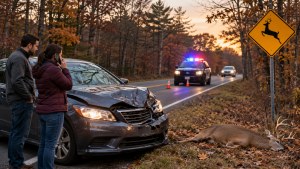
 If you drive in Plymouth County after work in November, you already know the light is gone by late afternoon and the roads are lined with trees. Deer are on the move at exactly that hour. A crash with an animal feels like bad luck, not something anyone is to blame for, and that assumption is where many people leave money and answers on the table. A Plymouth deer collision lawyer gets questions from drivers who were hurt, from passengers who were not in control of anything, and from people whose car was hit by another vehicle that swerved. Here are the questions that come up most, answered with what the state tells drivers.
Why is November such a bad month?
MassWildlife’s September 2026 release, Drivers, brake for moose and deer, explains the timing. White-tailed deer breed from late October into early December, and activity is highest in the early morning and the evening. The release cites MassDOT data showing that 25 percent of the reported collisions counted for 2018 through 2022 happened in November, and about 48 percent between October and December. The release does not give a total number of crashes, and those figures come from the state, not from any one town, so treat them as a sign of the seasonal pattern.
The practical message is simple: the commute that was safe in August can be riskier now, even on a road you know well.
What does the state tell drivers to do?
The release advises slowing down where deer crossing signs are posted and staying alert at dawn and dusk. It also says not to swerve to avoid a deer, because swerving can create more risk and cause more damage than hitting the animal. That advice matters later, because a driver who veers into oncoming traffic or a tree has turned an animal strike into a much more serious crash.
Who pays for the car?
This is where your own policy comes in. The state’s guide to what is in a Massachusetts auto policy says comprehensive coverage pays for direct, accidental damage that is not caused by a collision with another vehicle, with theft, vandalism, fire and broken glass as examples. Collision coverage pays for damage from contact with another object whatever the cause. Both are optional and usually carry a $500 deductible. Which one responds to an animal strike depends on your policy and your insurer, so ask directly. If you did not buy either, a deer strike can leave you paying for repairs yourself. Check your declarations page and do not assume.
Who pays for medical bills?
Every Massachusetts auto policy includes personal injury protection, which the same page describes as a no-fault coverage with an $8,000 limit that covers medical expenses, up to 75 percent of lost wages and replacement services regardless of who caused the accident. A deer collision falls within that. It is a useful first layer, and it can run out quickly if you need imaging, therapy or time off work.
Is anyone at fault when an animal causes the crash?
Sometimes no one is, and that is simply how it goes. But the facts of a deer crash are often more complicated than they first look.
If another driver was following too closely, tailgating you when you braked, or hit you after you stopped for the animal, that driver may be responsible for the injuries that followed. If a vehicle swerved into your lane to avoid a deer and struck you, the question is whether that driver acted reasonably. A Plymouth deer collision lawyer will ask for the order of events, because the deer may be the start of the story and not the end.
Shared blame matters here too. Under the comparative negligence rule in G.L. c. 231, section 85, a person found more than half at fault cannot recover, and a smaller share reduces the recovery proportionally.
What should you do at the scene?
Get to a safe place if you can, turn on your hazard lights and call 911 if anyone is hurt. Stay away from an injured animal, which can be dangerous. Photograph the car, the road, any skid marks and the animal’s location. Note the time, the weather and the lighting, and ask any witnesses for names and numbers.
The state’s release also asks drivers to report all deer and moose collisions to the Environmental Police at 1-800-632-8075. It adds that a Massachusetts resident who is the driver or a passenger may take the deer to a MassWildlife office to have it officially tagged. A report creates a record that can matter when you speak with your insurer.
What about injuries that show up later?
A collision with a deer can throw you against the belt, the wheel and the door even at modest speed. Neck, back and shoulder pain often builds over a day or two. Get checked promptly, and tell the provider exactly how the crash happened. A gap between the crash and the first visit is something an insurer may try to use against you.
What if a moose is involved?
The release notes that moose are found in central and western Massachusetts, and that they are harder to see in low light because their eyes do not reflect headlights the way a deer’s do. It also says moose are less likely than deer to leave the road, so drivers should brake and stay alert when one is in or near the road. A moose is a good reason to take any reported sighting seriously.
Common mistakes after a deer crash
People often skip the police report because it seemed minor, repair the car before photographing it, or give a recorded statement to an insurer without thinking about how a casual remark might be used. They also sometimes assume the claim ends with the car, when an injury is the part that can last. Keep your records, take your time and ask questions before you sign anything.
Getting advice
If you were hurt in a crash that began with a deer, or you were struck by a driver who reacted to one, a free consultation can help you work out which coverage applies and whether anyone else shares responsibility. Bring the police report, your photographs, your medical records and your policy declarations page. The earlier you start, the easier it is to preserve the scene and the records.