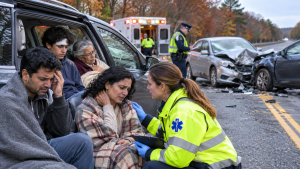
 Let’s put four people in one car. It is the Wednesday before Thanksgiving, and a family is driving down Route 3 to a relative’s house. Dev is at the wheel. His wife, Mira, rides in front, and their teenage son and his grandmother sit in back. Another car crosses the line and hits them head on at an angle, and all four people are hurt. Each of them is a passenger or a driver with a different question, and the answers depend on seat, relationship and insurance. A Plymouth passenger injury lawyer starts by working through exactly that, so this guide goes seat by seat.
The front passenger: Mira
Mira did not cause the crash and was not driving, so her first thought is that none of this should be her problem. In a practical sense she is right, but the path to payment still runs through insurance, and there are two possible routes.
The first is the other driver’s policy, since that driver is the one who crossed the line. The second is the policy on the car she was riding in. Mass.gov’s guide to what is in a Massachusetts auto policy describes personal injury protection as a no-fault coverage that pays medical expenses, up to 75 percent of lost wages and replacement services, to a limit of $8,000, regardless of who caused the accident. Whose personal injury protection applies to a passenger depends on the vehicle and the household, so an attorney can help sort it out quickly, because delays in getting bills paid are common when that question is left open.
The driver: Dev
Dev is in the most uncomfortable position, because an insurer’s first question will be whether he did anything to contribute. If he was braking, speeding or distracted, his insurer may argue he shares the blame. It might also matter whether anything he did affects what his family can recover from his own policy. The good news is that in this crash, the other driver crossed the line, which is a strong starting point for him. He should still avoid speculating in a recorded statement.
The back seat: their son
The teenager sits behind his father, wearing a seat belt, and hits his head on the window. Young passengers raise a few practical points. A parent or guardian usually handles the medical decisions and the paperwork, and special rules can apply to claims on behalf of a minor, so it is worth asking before anyone signs a settlement. Head injuries in particular can look minor at first, so he should be checked even if he says he is fine.
The back seat: the grandmother
Older passengers may have injuries that take longer to heal and pre-existing conditions that insurers love to bring up. If the grandmother already had a bad hip or arthritis, the other side may argue the crash did not cause her pain. A doctor’s records from before and after the crash are the most direct way to answer that, which is why she should see her own physician and tell them exactly what happened.
The coverage that quietly matters: the owner’s own policy
This is where passengers are often surprised. The state’s page notes that the compulsory coverage for bodily injury to others does not cover injury or death of a passenger in your own car, and that it applies only to accidents in Massachusetts. It describes optional higher limits, listed as $40,000 per person and $90,000 per accident, which can also protect passengers in your car and cover accidents outside Massachusetts. It also describes optional medical payments coverage of at least $5,000 for reasonable medical and funeral expenses for people in your car.
In plain terms, whether Mira, the teenager or the grandmother can look to Dev’s policy for more than the basics depends on what he chose to buy. A Plymouth passenger injury lawyer will want to see his declarations page, not just assume.
If the other driver has too little insurance, or none
When the driver who caused a crash has no insurance, or very little, the family’s own coverage may come into play. The same page describes compulsory coverage for injuries caused by an uninsured vehicle, and optional underinsured coverage for cases where the other driver’s limits are too low. Both depend on the policy that applies to each person, which is another reason to bring documents early.
How fault shapes everything
Whatever the policies say, the claim still turns on who was responsible. Massachusetts follows the comparative negligence rule in G.L. c. 231, section 85. A person found more than half responsible cannot recover, and a smaller share reduces the recovery by that share. Passengers are seldom blamed, though an insurer may ask about seat belts or about distracting the driver. Each person’s account should be accurate and consistent with the others.
What each person should do in the first days
Call the police and make sure everyone in the car is listed in the report, including the passengers. Photograph the vehicles, the road and everyone’s visible injuries. Get checked by a doctor, even those who feel only sore, and describe exactly how the crash happened. Keep copies of each person’s records and bills separately. Be careful with calls from insurers, because several may call at once and each may ask for a recorded statement.
A common trap: family dynamics
When the driver is a relative, passengers sometimes hesitate to file a claim because they worry about blaming someone they love. A claim against a policy is not an accusation, and it is often the only way the medical bills get paid. Still, the interests of the driver and passengers can differ, and it can be wise for each person to get independent advice.
Getting advice
If you were hurt as a passenger, a free consultation can help you work out which policies apply and who to call first. Bring the police report, photographs, medical records and the declarations page for the car, if you can get it. Starting early makes it easier to keep every claim organized.