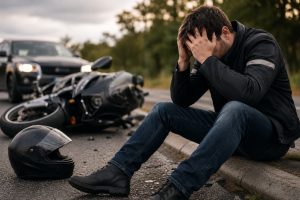
 When people talk about motorcycle accident injuries, they usually mean the physical ones. Road rash, broken bones, a herniated disc, a fractured collarbone. These are the injuries that show up on imaging, produce medical bills, and feel concrete enough to put in a claim. What gets talked about far less, and what gets left out of personal injury claims far too often, is what happens to a rider’s head, not from a concussion, but from the trauma of the experience itself.
PTSD, anxiety, depression, and the kind of deep-seated fear that keeps people from getting back on a bike are real injuries. They are medically recognized, they can be documented, and under Massachusetts law, they are absolutely compensable in a personal injury claim. If you were hurt in a motorcycle accident in Fall River and you’re struggling emotionally, that struggle has legal value, and a Fall River personal injury attorney can help make sure it’s accounted for.
What Actually Happens to Your Mind After a Serious Crash
A motorcycle accident happens fast. One second you’re riding, and the next you’re on the ground, or in the air, or watching a car door appear where it wasn’t a moment before. Your brain records that event at a level of intensity that normal experiences don’t reach. That’s not weakness. That’s how human neurology responds to genuine physical danger.
For many riders, the aftermath of that event doesn’t stay in the past where it belongs. Flashbacks while driving, nightmares that replay the crash, a sudden spike of panic when a car drifts too close in traffic, an inability to get on a motorcycle again, persistent anxiety that doesn’t have an obvious cause, these are all symptoms of a brain that’s still treating a past threat as a present one. Clinicians call it post-traumatic stress disorder, and it is exactly as serious in motorcycle accident survivors as it is in anyone else who’s been through a terrifying physical event.
Depression frequently develops alongside PTSD in accident survivors. Part of it is neurological. Part of it is situational: you may have lost your ability to ride, something that might have been a source of identity, freedom, or joy. You might have lost income. You might be dealing with physical pain that grinds you down daily. All of that compounds, and the result is sometimes a person who looks physically recovered to the outside world but who is genuinely struggling in ways that are hard to explain to people who weren’t there.
Massachusetts Law Recognizes Emotional Injuries
This is something a lot of accident victims don’t know: you don’t have to have a broken bone to have a compensable personal injury claim in Massachusetts. Emotional distress, psychological trauma, and PTSD are recognized forms of damages under Massachusetts personal injury law. They fall under the category of pain and suffering, which covers both the physical and the psychological impact of the injuries you sustained.
The law doesn’t draw a sharp line between your body and your mind when it comes to what you can recover after someone else’s negligence hurt you. If the accident caused genuine, documented psychological harm, that harm belongs in your claim.
What makes these claims work is documentation. Mental health treatment records from a therapist or psychiatrist, a diagnosis from a medical professional, records showing how the psychological symptoms have affected your daily life, your ability to work, your sleep, your relationships, all of this builds the evidentiary foundation for a psychological injury claim. The more thoroughly your condition is documented by qualified providers, the stronger that component of your case becomes.
The Specific Challenge of Motorcycle PTSD Claims
Psychological injury claims in any personal injury case face a common challenge: insurance companies are conditioned to be skeptical of things they can’t see on an X-ray. With motorcycle riders, that skepticism is sometimes layered on top of existing bias. Adjusters who already assume riders are reckless may be quick to attribute post-accident anxiety to some character trait of the rider rather than to the trauma of the crash itself.
This is exactly why having a personal injury lawyer in Fall River who understands how to build and present psychological injury claims matters so much. Your attorney will work with your treating mental health providers to document the diagnosis, causation (connecting the PTSD or anxiety directly to the accident), the severity of the symptoms, and the prognosis. If expert testimony is needed, your attorney can retain a qualified mental health professional to speak to the nature and impact of your condition.
The argument your attorney makes is not abstract. It’s specific: this person, who had no prior history of PTSD or significant anxiety disorder, was involved in a motorcycle crash caused by someone else’s negligence on a specific date. In the weeks and months that followed, they developed documented symptoms including nightmares, intrusive memories, hypervigilance in traffic situations, and avoidance of riding. They sought professional treatment. Their daily life has been materially affected. That is what we are asking to be compensated for, and it is both legally valid and well-documented.
Fear of Riding Again: A Real and Compensable Loss
One of the more emotionally charged dimensions of motorcycle PTSD is the loss of riding itself. For a lot of riders, motorcycling isn’t just transportation. It’s a hobby, a community, a form of stress relief, an expression of independence. When a crash takes that away, not physically but psychologically, not because you can’t ride but because you can’t face it, the loss is genuine and meaningful.
Under Massachusetts personal injury law, the loss of enjoyment of life is a recognized category of non-economic damages. If the accident has cost you the ability to participate in activities that were a meaningful part of your life before, including riding, that loss has legal value in your claim. It won’t appear as a line item on a medical bill, but it can be documented through your own account of how your life has changed, corroborated by family and friends who can speak to how different you are now compared to before the crash.
How to Start Documenting Your Psychological Symptoms
If you’re experiencing anxiety, depression, nightmares, intrusive memories, or a persistent fear response related to your accident, the first step is to tell your doctor. Your primary care physician can make an initial assessment and refer you to a therapist or psychiatrist if appropriate. Getting that professional involvement started creates the medical record you need.
Keep a personal journal, not for anyone else to read initially, but for yourself. Note when you have nightmares, what triggered a panic response, how your sleep is going, what activities you’ve avoided. This kind of contemporaneous personal documentation is something your attorney can use to show the ongoing, day-to-day reality of what you’re dealing with.
Be honest with every provider you see about the full scope of how you’re feeling. People sometimes downplay psychological symptoms out of habit, out of a sense that they should just push through, or because they’re not sure it’s “serious enough” to mention to a doctor. It is. Mental health symptoms following a traumatic accident are legitimate medical issues, and the more completely they’re documented, the better protected your legal claim is.
Reach Out to a Fall River Personal Injury Attorney
If you were hurt in a motorcycle accident in Fall River and you’re dealing with the psychological aftermath alongside the physical recovery, your claim should reflect both. Too many riders walk away from the legal process with compensation only for what shows up on an MRI, leaving the emotional cost of what happened on the table entirely.
A personal injury lawyer in Fall River who handles motorcycle cases will take the full picture of your injuries seriously, not just the ones you can show on a scan. The consultation is free and confidential. You don’t have to have everything figured out before you call. That’s what the attorney is there to help with.