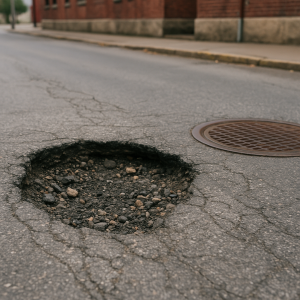
 Driving in Fall River means dealing with older roads, heavy traffic, winter freeze cycles, and construction zones. Potholes and sunken or exposed manhole covers are common. When one of these damages your tires, wheels, suspension, or steering, the question comes up fast. Is the City of Fall River responsible for the damage?
The short answer is sometimes yes. The longer answer depends on Massachusetts law, notice rules, timing, proof, and how the damage happened. This article explains how liability works, what you must prove, and when it makes sense to speak with a Fall River auto accident lawyer.
When a Town Can Be Liable for Road Damage
Massachusetts law allows cities and towns to be held responsible for injuries and property damage caused by defective public ways. This includes roads, sidewalks, potholes, and manhole covers.
In Fall River, liability usually falls under Massachusetts General Laws Chapter 84. This law governs defects in public ways.
To hold the city responsible, you must show four things.
- The road defect existed.
- The city had notice of the defect or enough time to discover it.
- The defect caused the damage.
- You were reasonably using the road.
If one of these elements is missing, the claim may fail.
What Counts as a Road Defect in Fall River
A road defect is a condition that makes the roadway unsafe for ordinary travel.
Common examples in Fall River include
• Deep potholes that damage tires or rims
• Collapsed pavement near drainage systems
• Manhole covers sitting too high or too low
• Loose or missing manhole covers
• Broken asphalt edges near construction zones
• Uneven pavement caused by utility work
Minor imperfections usually do not qualify. Massachusetts courts look at whether the defect posed a real danger to drivers using reasonable care.
Depth matters. Location matters. Visibility matters. Speed and traffic conditions matter.
Notice Is the Key Issue in Most Claims
The City of Fall River is not automatically responsible for every pothole or exposed manhole.
You must show that the city had notice of the defect.
Notice can be actual or constructive.
Actual Notice
Actual notice means the city knew about the problem.
This can come from
• Prior complaints from residents
• 311 service requests
• Police or public works reports
• Previous accidents at the same location
• Utility company notices
If a pothole or manhole issue was reported and not fixed within a reasonable time, liability becomes more likely.
Constructive Notice
Constructive notice means the defect existed long enough that the city should have known about it.
Courts look at
• Size and severity of the defect
• How long it likely existed
• Weather conditions
• Road usage
• Inspection schedules
A pothole that formed overnight after a storm is different from one that sat unfixed for weeks.
Manhole Covers and Utility Responsibility
Manhole covers add another layer of complexity.
Not every manhole belongs to the city.
Some are owned or maintained by
• Water departments
• Sewer departments
• Gas companies
• Electric utilities
• Telecom providers
If a utility owns the manhole, liability may fall on that company instead of the city. A Fall River personal injury lawyer can help identify ownership using public records and permits.
Improperly seated covers, missing bolts, or pavement collapse around the manhole can all create valid claims if notice can be shown.
Damage That Can Be Recovered
You may be able to recover costs for:
• Blown tires
• Bent or cracked rims
• Suspension damage
• Alignment issues
• Steering damage
• Axle or control arm damage
• Wheel bearings
• Underbody damage
You must prove the damage came from the road defect, not normal wear.
What You Must Do After the Accident
Your actions after the incident matter more than most people realize.
Document the Scene Immediately
Take clear photos of
• The pothole or manhole
• Its depth or height difference
• Your damaged tire or suspension
• Street signs or landmarks
• The exact location
Photos taken days later may not show the same condition.
Get Repair Estimates
Keep invoices, estimates, and mechanic reports. Ask the mechanic to note that the damage is consistent with striking a road defect.
Report the Defect
Report the pothole or manhole issue to Fall River public works as soon as possible. This creates a record and helps establish notice.
Preserve Dashcam or GPS Data
Dashcam footage or vehicle data can help prove speed and location.
Deadlines You Must Follow in Massachusetts
Deadlines are strict. Under Massachusetts law, you generally must:
• Give written notice to the city within 30 days
• File a lawsuit within three years
Missing the notice deadline can bar the claim even if the city was clearly at fault.
The notice must include
• Your name and address
• The date and time of the incident
• The exact location
• A description of the defect
• A description of the damage
Errors weaken claims. This is a common reason people contact a personal injury attorney in Fall River early.
Limits on What You Can Recover
Massachusetts law caps damages for road defect claims. Recovery is generally limited to $5,000 for property damage or injury caused by a defective public way. This cap applies even if your actual losses are higher.
If injuries are involved, other legal theories may apply. A Fall River personal injury lawyer can evaluate whether additional claims exist.
When a Claim Is Likely to Fail
Some claims are denied for common reasons.
• The defect was too minor
• The city had no notice
• The damage occurred immediately after a storm
• Speed or distracted driving contributed
• The damage resulted from normal wear
• The wrong entity was notified
This does not mean you should assume you have no case. It means evidence and timing matter.
Accidents Involving Loss of Control
Sometimes a pothole or manhole does more than damage your vehicle. It causes you to lose control and collide with another vehicle or object.
In these cases, liability may expand beyond a simple property claim. A car accident attorney in Fall River can analyze
• Whether the road defect caused the loss of control
• Whether another driver shares fault
• Whether injuries change the claim type
• Whether higher damage limits apply
These cases require careful investigation.
How Comparative Fault Works
Massachusetts follows comparative fault rules.
If you are partly responsible, your recovery may be reduced. Examples include:
• Driving too fast for conditions
• Ignoring visible hazards
• Following too closely
• Driving with worn tires
If you are more than 50 percent at fault, recovery may be barred.
Why Legal Help Matters Even for Vehicle Damage
Many people try to handle these claims alone. Some succeed. Many do not. A Fall River auto accident lawyer can:
• Identify the correct responsible party
• Secure maintenance and complaint records
• Prove notice
• Handle strict notice requirements
• Negotiate with city insurers
• Avoid procedural mistakes
Cities deny claims routinely. Preparation changes outcomes.
How Long These Claims Take
Simple property damage claims may be resolved in a few months. Disputed claims take longer, especially if litigation is required. Utility-related manhole cases often take more time due to ownership disputes.
Final Thoughts
Fall River is not automatically liable for every pothole or exposed manhole. Liability depends on notice, timing, and proof.
If your tires or suspension were damaged, act quickly. Document everything. Meet deadlines. Identify the right party.
If the damage is significant or injuries are involved, speaking with a car accident attorney in Fall River can protect your rights and prevent costly mistakes.
Road defect cases are technical. Preparation wins them.