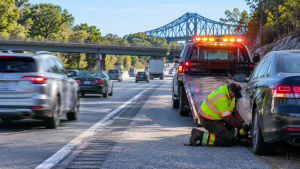
 Ninety seconds can change everything on a highway shoulder. A tow operator is hooking up a car on I-195. A state vehicle has its lights on beside a work zone. A driver with a flat tire is crouching by the rear wheel. Traffic is passing at highway speed a few feet away, and every one of those drivers has about two seconds to decide whether to change lanes or not.
A Fall River roadside accident lawyer works with people who were on the wrong end of that decision. This article follows the roadside timeline, starting with what the law says drivers have to do.
Second zero: you see the lights
The state’s page on the Move Over law applies when a driver approaches a stationary emergency, maintenance or recovery vehicle that has its lights flashing on a highway. It names emergency response vehicles, meaning fire apparatus, police vehicles, ambulances and disaster vehicles, and highway maintenance vehicles owned or operated by government bodies or their contractors. It doesn’t define recovery vehicles, so whether a particular tow truck or service vehicle is covered is the kind of thing a lawyer would check.
The instructions are simple. On a highway with at least four lanes, with two going the same direction, a driver should make every effort to change lanes away from the stationary vehicle. If changing lanes isn’t practical, the driver must slow to a reasonable and safe speed for conditions and proceed with due caution.
Second ten: the driver decides
Some drivers don’t see the lights at all. Others see them late and brake hard, or swerve into the next lane without looking. A driver who is distracted, tired or following too closely behind another vehicle may only notice at the last moment. These are the situations that produce roadside crashes, and each leaves different evidence: skid marks, dashcam footage, the position of the vehicles and whether the lights were visible from far enough away.
Second ninety: the aftermath
Roadside crashes can involve people with very different jobs: a tow operator, a highway worker, a police officer or a stranded driver. If you were hurt while working, workers’ compensation may be part of the picture, and a claim against the driver who hit you may also be possible. If you were a stranded motorist, the situation can involve your own insurer and the other driver’s. Which path applies depends on facts that a lawyer can sort out early.
What the penalties look like
According to the state page, violating the law may bring a fine of up to $100, plus possible points on a driving record, higher insurance premiums and potential civil liability if someone is harmed. Enforcement isn’t rare. Western Mass News reported in June 2025 that Massachusetts State Police had issued 4,404 citations for Move Over violations since the start of that year.
A ticket and a personal injury claim are separate things. A citation can be useful background, but your claim depends on showing how the crash happened and what it cost you.
If you’re stranded on a shoulder
Safety comes before everything else. If you can do so safely, pull as far off the road as possible, turn on your hazard lights and consider exiting on the side away from traffic. Stay out of the lane and away from the rear of the vehicle. If you need help, call and wait somewhere protected, such as behind a barrier, rather than standing near your car.
What the other side may say
After a roadside crash, a common response is that the lights weren’t visible, that the vehicle was too close to the lane, or that the driver had nowhere to go. For stranded drivers, an insurer may suggest the car should have been moved farther off the road. For workers, a company may question how the work area was set up. None of those arguments is automatically right, but they’re predictable, which is why early photos of the lights, the lane and the distances can be so valuable.
If you were hit
Get medical care, even if you feel fine. Roadside crashes often involve higher speeds and the injuries can be serious. Then, as soon as it’s safe:
- Make sure police respond and a report is made.
- Record the lights on any emergency or work vehicle and how visible they were.
- Photograph the scene, the position of the vehicles and the road.
- Get names and numbers from witnesses, including other drivers who stopped.
- Note the make, plate and any company markings on the vehicle that hit you.
Be careful with quick calls from insurers. You can take time before giving a recorded statement, and you’re not obliged to guess at speeds or distances.
If you were hurt on the shoulder of a highway, whether you were working or stranded, a Fall River roadside accident lawyer can help you understand which rules and insurance policies apply and make sure the evidence is preserved.