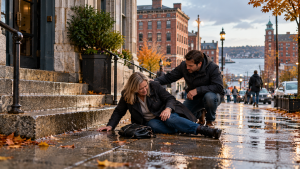
 Fall River has a built environment unlike almost any other city in Massachusetts. The granite mill buildings that once powered the city’s textile industry stand as some of the most striking industrial architecture in New England, and many of them have found new lives as apartments, office space, restaurants, and retail. The waterfront along Mount Hope Bay has attracted redevelopment that brings new businesses and foot traffic to areas that sat underutilized for decades. Historic commercial blocks throughout the city house everything from corner stores to medical offices to entertainment venues.
All of this is genuinely good for Fall River. It is also, from a premises liability perspective, a concentrated collection of aging structures with maintenance challenges, uneven surfaces, dated stairwells, and exterior conditions that can turn hazardous quickly when rain, wind, or the first freezes of autumn arrive.
Slip and fall accidents in Fall River happen in grocery stores and parking lots, just as they do anywhere. But they also happen in places specific to this city’s character: the repurposed mill building with granite entry steps worn smooth by a century of foot traffic, the waterfront restaurant patio with uneven deck boards, the downtown commercial block where the sidewalk has been heaving for two years and the adjacent property owner has done nothing about it.
What Makes Fall River’s Older Properties Particular Liability Risks
Massachusetts premises liability law requires property owners to maintain their premises in reasonably safe condition for invited guests and business visitors. That standard applies equally to a brand-new shopping plaza and a 19th century mill building converted into loft apartments. But the maintenance challenges are not equal. Old buildings accumulate hazards in ways that newer construction does not.
Granite and stone entry steps common in Fall River’s historic commercial buildings become genuinely treacherous when worn. The texture that once provided traction disappears over decades of use, leaving a surface that can be as slick as polished marble when wet. Property owners are required to maintain adequate traction on entryways, which means treating worn stone surfaces, adding non-slip strips or mats, and ensuring that weather-related accumulations of water and debris are addressed promptly.
Cast iron and wooden fire escapes on older Fall River buildings present another category of hazard. When they serve as primary egress routes and are not properly maintained, rust, rot, and structural weakness can make them genuinely dangerous. Falls from exterior fire escapes and staircases have produced some of the most serious injuries in Fall River premises liability cases.
The waterfront development corridor brings its own specific hazards. Floating dock systems, boardwalk surfaces, and waterfront patios all create slip and fall risks that are amplified by exposure to moisture and salt air. A restaurant with a waterfront deck has a particular obligation to ensure that deck surfaces are maintained in a non-slip condition, that drainage prevents standing water, and that structural components are inspected and kept in safe condition.
The Autumn Dimension in Fall River
Fall River’s geography, situated on the eastern shore of Mount Hope Bay and bordered by the Taunton River, means that autumn brings moisture-laden air that keeps surfaces wet longer than inland locations. The combination of fallen leaves on historic stone and brick surfaces, morning fog rolling off the water, and the early-season rain events of October creates particularly hazardous conditions on the city’s older exterior surfaces.
Property owners in Fall River who operate retail businesses, restaurants, or residential rental properties have a legal obligation to manage these seasonal hazards with reasonable diligence. A historic building’s charm does not reduce the owner’s duty to keep it safe. If anything, the known maintenance challenges of older structures increase the foreseeability of hazardous conditions and the owner’s responsibility to actively monitor and address them.
Proving a Slip and Fall Case in Fall River
The core of a Fall River slip and fall claim is establishing that the property owner knew or should have known about the hazardous condition that caused your fall and failed to correct it or warn you about it within a reasonable time. In cases involving older buildings with documented maintenance issues, this standard is often easier to meet than people expect.
A worn granite step that has been visibly smooth for years is a condition the owner has had every opportunity to observe and address. A deck board that local contractors have flagged as needing replacement is a known hazard. A sidewalk adjacent to a Fall River commercial property that tenants have complained about and photographed on social media is a documented problem with documented owner awareness.
A personal injury lawyer in Fall River will investigate the history of the specific hazard that caused your fall, including any prior complaints, inspection reports, maintenance records, or evidence that others have raised the same issue. This investigation is most productive when it begins quickly, before records get lost and before the hazard gets quietly fixed without any acknowledgment of how long it existed.
If You Were Hurt in Fall River This Fall
Photograph everything before you leave the scene. Report the incident to the property owner or manager in writing so there is a documented record. Get medical attention and keep every appointment that follows. Then call a personal injury lawyer in Fall River for a free consultation before you speak to any insurance adjuster.
Fall River’s character is inseparable from its history, and that history lives in the buildings people work in, shop in, eat in, and walk past every day. When those buildings become hazards that hurt people, the law is clear about who is responsible. Make sure you know your rights.