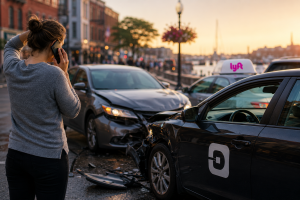
 Rideshare has become part of daily life in New Bedford. People use Uber and Lyft to get to the waterfront, to skip the parking headache during summer events downtown, to get home safely after a night out. It feels like any other ride. So when something goes wrong and you get hurt, the natural assumption is that you file a claim with Uber or Lyft and they take care of it.
That is not exactly how it works. Rideshare accident claims in Massachusetts operate under a layered insurance structure that most people have never heard of, and figuring out which policy covers you depends on one very specific detail: what the driver was doing in the app at the exact moment the crash happened. A car accident lawyer in New Bedford who handles these cases regularly understands that system. Most injured people do not, and that gap in understanding costs them.
The Three Phases That Determine Everything
Under Massachusetts law, rideshare companies like Uber and Lyft are classified as Transportation Network Companies, and they are required to carry insurance that kicks in at different levels depending on the driver’s status in the app. There are three distinct phases, and each one triggers a completely different insurance picture.
Phase one: the app is off. If the driver is not logged into Uber or Lyft at all when the accident happens, only their personal auto insurance applies. Uber and Lyft have zero obligation during this period. Massachusetts requires drivers to carry a minimum of $20,000 per person for bodily injury, which can be shockingly low if you have serious injuries.
Phase two: logged in, waiting for a ride request. Once a driver logs into the app and is available but has not yet accepted a ride, Uber and Lyft are required to provide contingent liability coverage of $50,000 per person and $100,000 per accident for bodily injury. This coverage only kicks in if the driver’s personal insurer denies the claim, which often happens because personal auto policies frequently exclude coverage when the vehicle is being used for commercial purposes. This gap creates real complications.
Phase three: ride accepted or passenger on board. From the moment a driver accepts a ride request until the passenger gets out of the car, Uber and Lyft must carry $1,000,000 in third-party liability coverage. This is the strongest protection in the system and covers passengers, people in other vehicles, cyclists, and pedestrians who are hit by the rideshare driver. If you were hurt while a ride was in progress, this is the coverage that applies to your claim.
Here is why this matters so much: insurance companies will look at the driver’s app activity down to the minute to determine which phase was active when your accident happened. A difference of a few seconds can mean the difference between a $50,000 policy and a $1,000,000 policy. That is not a small distinction, and it is not something you want to sort out on your own while recovering from an injury.
What If Another Driver Caused the Crash?
Not every rideshare accident is the rideshare driver’s fault. If you were a passenger in an Uber and another car ran a red light and hit you, the at-fault driver’s insurance is the primary source of compensation. But here is where it gets interesting. If that driver has no insurance or low coverage limits, the rideshare company’s Uninsured and Underinsured Motorist protection can step in as a safety net during Phases two and three. In Phase three, that UM and UIM coverage can be significant.
A New Bedford personal injury attorney handling rideshare cases knows how to investigate which policies were active, request the app data that shows the driver’s status at the time of the crash, and identify every available source of compensation. This kind of multi-layered investigation is standard in these cases and almost impossible to do effectively without legal help.
The Screenshot You Need to Take Right Now
If you are ever in an accident while riding in an Uber or Lyft, one of the most important things you can do in that moment is take a screenshot of the trip page in the app before you close it. That screenshot shows the driver’s information, the trip status, and the time of the accident. It is evidence that the ride was in progress, which directly affects which insurance applies and how much coverage is available.
People forget to do this because they are shaken up, they are focused on their injuries, and nobody has told them it matters. Now you know.
Why Rideshare Companies Are Harder to Deal With Than Regular Insurers
When you file a claim after a standard car accident, you are generally dealing with one insurance company. In a rideshare accident, you may be dealing with the rideshare company’s insurer, the driver’s personal insurer, and potentially a third driver’s insurer all at the same time. Each of these companies has an incentive to argue that one of the others is responsible. The driver’s personal insurer will often deny coverage based on commercial use exclusions. The rideshare company’s insurer will look for reasons to argue that the driver was in a lower phase than the evidence shows.
Meanwhile, you are recovering from an injury and trying to pay your medical bills. That is not the moment to be going back and forth with multiple insurance adjusters who each have legal teams and years of experience handling these disputes.
Summer Makes This More Common Than You Might Expect
Rideshare usage spikes in the summer in New Bedford, especially around waterfront events, the harbor area, and on nights when people choose a safe ride home over driving. More rides mean more potential for accidents. Drivers who are working long hours to take advantage of summer demand can be fatigued. Distracted driving is a constant issue for rideshare drivers who are monitoring a phone app while trying to navigate unfamiliar streets.
If you have been hurt in a rideshare accident, whether as a passenger, a pedestrian, or someone in another vehicle, contact a personal injury lawyer in New Bedford for a free consultation. The claim process for these cases is genuinely different from a standard accident claim, and getting it right from the start matters. A New Bedford personal injury attorney who knows the rideshare insurance system will make sure you pursue every dollar you are entitled to rather than settling for whatever the first insurer puts on the table.