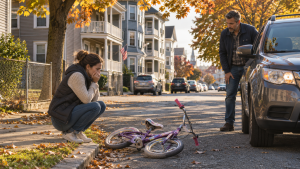
 In June, a 5-year-old boy riding a bicycle on Cherokee Street died after being struck by a vehicle. Police said the driver stayed at the scene and cooperated with investigators. It happened on a Wednesday afternoon, the kind of ordinary hour when kids are outside because school is done and the weather is good.
Almost every parent in New Bedford heard about it. Many of them went out and stood on the sidewalk watching their own kids for a while. This article isn’t about that case, and nobody should read it as a comment on it. It’s for the parent, grandparent, or guardian who is dealing with something that happened to their own child on a bike, whether it was a broken arm, a head injury, or something worse, and who is trying to figure out what they’re supposed to do next.
The legal side is not the first priority. Medical care is. But there are a few things that are better understood early.
A child’s claim is not the same as an adult’s
Courts don’t expect a seven-year-old to ride like a commuter. Under Massachusetts law, a child’s conduct is generally judged against what’s reasonable for a child of that age, experience, and maturity. A kid who veers a little, who doesn’t see a car pulling out, who rides off a driveway without stopping, is behaving like a kid. Drivers are expected to anticipate that, especially on residential streets. New Bedford has plenty of narrow ones, lined with parked cars and triple-deckers, where a child can come out from between two vehicles with almost no warning. A careful driver on a street like that goes slowly.
The “he darted out” defense is common, and it’s not always wrong. But it needs to be tested against how fast the driver was going, how closely they were watching, and whether they could have stopped. Those questions have answers, and a lawyer can often get them from measurements, video, and the vehicle’s own data.
The helmet question
Massachusetts requires bicyclists age 16 and under to wear a helmet. If your child wasn’t wearing one, expect the insurance company to bring it up. How much it matters depends on the facts, including what injuries were caused or made worse by the lack of a helmet. It’s a conversation to have with a lawyer rather than something to answer on the phone with an adjuster. Please don’t let guilt about it keep you from seeking help. Plenty of kids who are hit by cars were wearing helmets, and plenty of drivers who hit them were at fault.
Two clocks, not one
This part surprises many parents. When a child is injured, there are usually two different claims. One belongs to the child, for pain, injury, and any lasting effects. The other belongs to the parents, for the medical bills and, in some cases, the loss of the child’s companionship.
Under Massachusetts law, the time limit on a child’s own claim is generally paused until the child turns 18. The parents’ claim for medical expenses usually follows the ordinary three-year clock. So you could have a child’s claim that’s technically still open and a parents’ claim that’s about to expire. Don’t try to figure out the timing yourself, and don’t assume you have years. Evidence doesn’t wait.
Insurance, step by step
Massachusetts personal injury protection can cover a cyclist who is struck by a motor vehicle, usually through the policy on the vehicle that hit them or, if that isn’t available, through a policy in the child’s household. That helps with early medical bills regardless of fault. Beyond PIP, a claim against the driver’s liability insurance covers the larger losses.
When a child’s claim settles, the court will usually need to approve the settlement, and the money is often placed in a restricted account until the child is an adult, with limited withdrawals for needs like medical care. It’s designed to protect the child. It also means the process takes longer than people expect.
What isn’t on the bill
Children who’ve been in a serious crash can be affected for a long time in ways that don’t show up on an X-ray. Nightmares. Fear of the street. A kid who used to ride everywhere and now won’t go near the bike. These are real consequences, and they’re part of what a claim can address. Pediatricians, therapists, and school counselors can document them, and that documentation matters later.
Practical steps in the first week
Keep every discharge paper and bill. Take photos of the injuries as they change. Photograph the spot where it happened, including parked cars, signs, and the sightline a driver would’ve had. If the bike or helmet survived, store them somewhere safe and don’t repair or throw them away, since they can show impact points. Write down what your child says about the crash, in their words, as soon as they’re able, and don’t coach them. Ask neighbors if their doorbell cameras caught anything, and ask quickly.
Fall afternoons
With the sun setting earlier, kids ride in the low light of 4 or 5 p.m. just as drivers are coming home from work. It’s the same pattern every fall. If your child rides, lights on the bike and bright or reflective clothing help drivers notice them. They don’t shift responsibility off a driver who isn’t paying attention, but they’re worth doing anyway.
Talking to someone
A personal injury lawyer in New Bedford who handles cases involving children can explain the process, deal with the insurance companies so you don’t have to, and tell you honestly what the next few months will probably look like. The first consultation is free, and there’s no fee unless there’s a recovery.