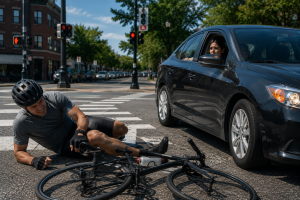
 Most people picture a bicycle accident as a car drifting into a rider from behind, or a parked door swinging open. But if you look at where bike crashes actually happen in Massachusetts, intersections account for roughly a third of them. And the two collision types that make up the majority of those intersection crashes, what riders call the right hook and the left cross, are ones where Massachusetts law is remarkably clear about who is responsible. If you were hurt in one of these crashes in Fall River, a personal injury lawyer in Fall River can help you understand exactly why the driver is almost certainly liable, and what that means for your claim.
The Right Hook: When a Driver Passes You and Then Turns Into You
Here is how the right hook happens. You are riding your bicycle along the right side of the road, moving with traffic. A car passes you or pulls alongside you. Then, without warning, that driver swings right to turn into a driveway, side street, or intersection, directly crossing your path. You have nowhere to go. The front of their car meets the side of your bike, and you go down.
From inside the car, the driver will often say they didn’t see you, that you came out of nowhere, that they didn’t realize you were there. None of that is a legal defense. Massachusetts General Laws Chapter 90, Section 14 is explicit: a driver who overtakes and passes a cyclist traveling in the same direction cannot make a right turn at an intersection or driveway unless that turn can be made at a safe distance from the cyclist and at a reasonable speed. That law exists precisely because this crash type is so predictable and so preventable.
The law also adds something that might surprise people: it is not a defense for a driver who hits a cyclist that the bicycle was riding to the right of other traffic. This directly addresses the argument drivers and insurers often make, which is that the cyclist was in an unexpected position on the road. Massachusetts already anticipated that argument and rejected it legislatively.
When a driver right-hooks a cyclist in Fall River and that cyclist is injured, the driver’s violation of Section 14 establishes negligence clearly. That doesn’t mean the insurance company hands over a fair settlement without a fight, but it means your Fall River personal injury attorney is working from a strong legal foundation.
The Left Cross: When an Oncoming Driver Turns Into Your Path
The left cross is the mirror image of the right hook, and it’s the scenario that kills more cyclists than probably any other collision type. You are riding straight through an intersection. An oncoming driver is waiting to turn left. They look for a gap in traffic and spot one, but they either don’t see you at all or misjudge how fast you’re moving. They turn left directly into your path.
Again, Massachusetts law addresses this directly. Section 14 requires a driver turning left within an intersection to yield the right of way to any vehicle approaching from the opposite direction, and that explicitly includes a bicycle riding to the right of other traffic or on the shoulder. The fact that the cyclist was in the bike lane and not in the center of the travel lane is not an excuse for the turning driver. The law says yield to oncoming cyclists. Full stop.
This crash type is devastating because of the physics involved. The cyclist is typically moving at speed through what should be a clear intersection when the car appears in their path. There is no time to brake meaningfully. The impact is often severe. Head injuries, broken bones, spinal trauma, and internal injuries are all common outcomes of left cross crashes.
Why “I Didn’t See You” Isn’t a Defense
Both the right hook and the left cross frequently come with the same explanation from the driver: they simply didn’t see the cyclist. This is treated in casual conversation as an accident, something unfortunate that just happened. Under Massachusetts law, it is negligence.
Drivers have a legal duty to look for cyclists before turning. The duty exists precisely because cyclists are smaller, faster than pedestrians, and easier to overlook than cars. Failing to see a cyclist who was lawfully using the road is a failure to exercise the reasonable care that the law requires. The outcome, an injury to a cyclist, flows directly from that failure. That is what negligence means in a personal injury case.
A Fall River personal injury attorney will build your case around the driver’s specific failure: what they should have seen, when they should have seen it, what they would have seen if they had looked properly, and what would have happened differently if they had followed the law. That factual reconstruction, supported by the accident report, photos, witness accounts, and sometimes traffic engineering analysis, is what turns a clear legal standard into a documented, winnable claim.
What Evidence Matters Most in Intersection Bike Crashes
Intersection crashes involve a lot of evidence that disappears fast. If you are physically able after a crash, the most valuable things you can do are take photos immediately: both vehicles, the road markings, any skid marks or debris, traffic signals, painted bike lanes, and the surrounding intersection layout. Get witness names before people disperse. Ask nearby businesses about surveillance cameras, because footage from storefronts facing an intersection can sometimes capture the collision from a useful angle.
Your bicycle itself is evidence. The damage patterns on the frame can help reconstruct where the impact occurred and the direction of force. Don’t repair or discard the bike before your attorney has had a chance to document it.
Some cyclists ride with GPS units or cycling apps running that record speed and location data. If you had any of that running at the time of your crash, preserve it. This data can be used to establish your speed, your position, and your trajectory at the moment of impact, all of which matter in disputed liability situations.
When the Insurance Company Says You Were Partly at Fault
Even in crashes where the driver’s violation of Section 14 is obvious, insurance companies don’t simply concede fault. They look for ways to attribute some percentage of responsibility to the cyclist. Common arguments include that the rider wasn’t using a light at dusk, that they weren’t wearing high-visibility clothing, that they were riding faster than expected, or that they made some late movement that contributed to the collision.
Massachusetts comparative negligence rules mean that your recovery is reduced by whatever percentage of fault is assigned to you, as long as that percentage is below 51. A cyclist found 15 percent responsible recovers 85 percent of their damages. The insurance company’s goal is to push that number up, because every percentage point costs you money.
Your attorney’s job is to push back with evidence. If the driver ran a red light, violated the overtaking statute, or failed to yield as required by law, those violations are the cause of the crash, not the color of your jacket. A skilled personal injury lawyer in Fall River knows the arguments insurers use in bicycle cases and knows how to counter them with the specific facts of your situation.
What You Can Recover After a Serious Intersection Bike Crash
Intersection crashes tend to produce more serious injuries than other bike accident types because the collision angles and speeds involved are often more severe. The compensation available reflects that. Medical expenses past and future, lost wages, reduced earning capacity if your injuries affect your career, pain and suffering, and the cost of replacing your bicycle and gear are all recoverable damages in a properly presented claim.
For cyclists who suffer serious injuries, the pain and suffering component of the claim is often the largest. These crashes can produce lasting physical effects, psychological trauma from the sudden and violent nature of the impact, and meaningful changes to how you live your daily life. A thorough Fall River personal injury attorney will document all of these dimensions, not just the medical bills.
Talk to a Fall River Personal Injury Attorney About Your Case
If you were hit by a car making a right turn into you or a left turn across your path in Fall River, Massachusetts law is almost certainly on your side. The challenge is making sure that legal advantage translates into fair compensation, which requires someone who knows how to preserve evidence, interpret the statutes correctly, and stand firm against an insurance company that would prefer to pay you as little as possible.
The initial consultation with a personal injury lawyer in Fall River is free, and representation in personal injury cases is contingency-based, meaning no upfront costs and no fee unless you win. Cyclists have strong legal rights in Massachusetts. The right attorney makes sure those rights actually mean something.