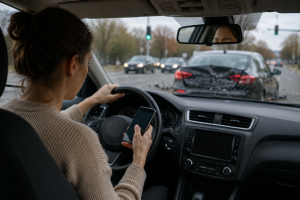
 You know what happened. The driver who hit you was looking at their phone. Maybe you saw it with your own eyes right before impact. Maybe the way the crash happened, a rear-end collision at a red light, a car drifting out of its lane on a straight stretch of road, made it obvious that the driver wasn’t watching the road. The challenge isn’t knowing it. The challenge is proving it in a way that holds up in a legal proceeding. A personal injury lawyer in Fall River who handles distracted driving cases knows exactly how that proof is built, and the process is more concrete than most people realize.
Why Distracted Driving Matters Beyond Simple Negligence
All car accident cases require proving that the other driver was negligent. Distracted driving by phone use adds an important dimension to that proof because Massachusetts has a hands-free law that makes phone use while driving a statutory violation. Under Massachusetts law, drivers are prohibited from using a hand-held electronic device while operating a motor vehicle. Violating that law while causing an accident establishes what’s called negligence per se, which means the violation of the statute itself is evidence of negligence. You don’t have to argue about whether a reasonable person would have been on their phone. The law already decided they shouldn’t have been.
That distinction matters for the strength of your claim and can also influence how the at-fault driver’s insurer evaluates the case. A clear statutory violation strengthens your attorney’s negotiating position.
Phone Records: The Most Direct Evidence
The most direct way to prove a driver was using their phone at the moment of a crash is to obtain their cell phone records. These records show, with timestamp precision, when calls were made or received, when text messages were sent or received, and when data was accessed. If those timestamps align with the time of the accident, the connection between phone use and the crash becomes documented fact rather than argument.
Obtaining these records requires a legal process. Your attorney can issue a subpoena for the driver’s cell carrier records once a lawsuit is filed, or in some cases can request preservation of the records early through a legal hold letter before they’re deleted or overwritten. Cell carriers retain records for varying periods, and acting quickly to preserve them matters.
The at-fault driver won’t volunteer their phone records. Their insurer certainly won’t request them proactively. This is another concrete reason why having a Fall River personal injury attorney working your case from an early stage produces better evidence than waiting to see how things develop.
Other Evidence That Establishes Distracted Driving
Phone records are the strongest direct evidence, but they’re not the only kind. Witness testimony is valuable. Someone who saw the driver looking at a screen, typing, or holding a phone to their ear in the moments before impact provides eyewitness corroboration that fits alongside the technical records.
The physical characteristics of the accident itself can support a distracted driving theory. A rear-end collision where there were no skid marks, suggesting the driver never braked, is consistent with a driver who didn’t see the situation developing in time to react. A lane departure on a straight road with no apparent mechanical cause is consistent with driver inattention. Accident reconstruction experts can analyze crash dynamics and contribute professional opinions about what the driver’s behavior suggests about their state of attention at the time.
If the at-fault driver made any statements at the scene about what they were doing, those statements are evidence. Patrol officers sometimes capture these in the accident report. Bystanders sometimes hear them. If the driver told someone they were sending a text, that admission becomes a piece of your case.
Dashcam footage, either from your own vehicle or from a bystander’s car, can sometimes show the at-fault driver’s posture or the position of their hands and head in the moments before impact. Business surveillance systems pointed at roadways increasingly capture accident footage as well. Your attorney will pursue all of these sources systematically in the early stages of a case.
What If the Driver Denies It?
Drivers rarely admit to being on their phones at the scene of an accident. Most deny it. The legal process doesn’t rely on their admission. Discovery, the formal evidence-exchange process in civil litigation, allows your attorney to compel production of the phone records, take the driver’s deposition under oath, and ask them directly and specifically what they were doing in the minutes before the crash. Lying under oath in a deposition is perjury. Most people, when confronted in a formal legal setting with the specific question backed by the context of timestamped records, don’t maintain denials that the records contradict.
In cases where the phone records align with the accident time and the driver denies phone use, your attorney is in a strong position. Presenting that combination to a jury, a timestamped record showing activity on the defendant’s phone at the exact moment of impact alongside a denial of phone use, tends to be persuasive.
What Compensation Looks Like in Distracted Driving Cases
From a damages standpoint, distracted driving cases are personal injury cases like any other: medical bills, lost wages, pain and suffering, and future costs if injuries are serious. What the phone use evidence adds is persuasive power. Cases where liability is clear tend to resolve more favorably than cases where fault is disputed, and cases where the at-fault driver was violating a specific law at the time of the crash tend to produce more pressure on the insurer to settle fairly.
If you were hit by a distracted driver in Fall River, you likely already know it. What you need is an attorney who can build the documented, evidence-backed case that turns what you know into what can be proven. A personal injury lawyer in Fall River will make that happen. The consultation is free, the work is contingency-based, and the evidence gets harder to recover the longer you wait.