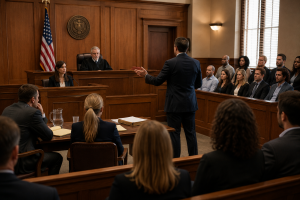
 Most people involved in personal injury claims never see the inside of a courtroom. The overwhelming majority of cases, well over 90 percent by most estimates, settle before trial. But “most cases settle” is not the same as “your case will settle,” and walking into the process without understanding what trial actually looks like leaves you dependent entirely on your attorney’s judgment without being able to participate meaningfully in the decision-making. That’s not ideal, and a good personal injury lawyer in Fall River will make sure you understand the road from filing a lawsuit to a jury verdict before you ever have to decide whether to push forward or accept a settlement offer.
Where Personal Injury Cases Are Tried in Fall River
The venue for your trial depends on the amount in dispute. Smaller personal injury cases, generally those under $50,000, are handled in Fall River District Court at the Fall River Justice Center on South Main Street. Cases involving larger damage amounts, which includes most cases involving serious injuries, are tried in Bristol County Superior Court, which also holds sessions at the Fall River Justice Center. Your attorney will file in the appropriate court based on the value of your claim.
Both courts have their own procedural rules, their own judge assignments, and their own rhythms. A Fall River personal injury attorney who regularly practices in these courts brings familiarity that matters. Knowing how a particular judge tends to handle certain motions, how Bristol County juries have responded to similar cases, and how long the docket currently runs in each court are all pieces of strategic knowledge that influence case decisions.
The Timeline from Filing to Trial
Filing a lawsuit is not the same as going to trial. Between the complaint and the courtroom, there’s a significant stretch of procedural work called discovery. Both sides exchange written questions called interrogatories, request documents from each other, and conduct depositions, which are sworn out-of-court testimonies taken by attorneys from parties and witnesses. In a personal injury case, depositions typically include the plaintiff, the defendant, and sometimes treating medical providers and expert witnesses.
Discovery in a personal injury case can take anywhere from several months to over a year, depending on the complexity of the injuries, the number of witnesses, and how cooperative or adversarial the other side is being. After discovery closes, there’s typically a period of pretrial motions where each side may try to limit what evidence the jury sees or argue that certain issues should be decided by the judge rather than submitted to a jury.
From filing to trial, cases in Bristol County Superior Court can take two to three years depending on the court’s schedule. This is a real consideration in deciding whether to push for trial or accept a reasonable settlement offer.
What a Personal Injury Trial Actually Looks Like
Once trial begins, jury selection comes first. Both sides question potential jurors to identify any biases or connections that might affect their ability to decide the case fairly. Each side has the ability to excuse a certain number of jurors without providing a reason, and can excuse others for cause if a specific bias is shown. Jury selection in a personal injury case can take anywhere from half a day to several days depending on the complexity of the issues.
Opening statements follow, where each attorney gives the jury a preview of what they intend to prove. Then the plaintiff, meaning you or your attorney on your behalf, presents evidence first. This includes witness testimony, medical records, photographs, expert opinions, and any other documentation supporting your injuries and the defendant’s fault. Your attorney presents this case; you testify, and so do your treating doctors if necessary.
The defendant then presents their case, which typically includes their own witnesses and potentially their own medical experts who may offer different opinions about your injuries. Your attorney cross-examines those witnesses.
Closing arguments let each side summarize the evidence and make the case for why the jury should decide in their favor. The judge then gives the jury legal instructions about how to apply the law to the facts, and the jury deliberates in private until they reach a verdict.
What the Jury Is Actually Deciding
A jury in a Massachusetts personal injury case decides two main questions: liability, meaning whether the defendant was negligent and by how much, and damages, meaning what the plaintiff’s losses are worth. Under comparative negligence rules, the jury assigns percentages of fault. If the defendant is found 80 percent at fault and you are found 20 percent at fault, your damages are reduced by 20 percent. As long as your fault percentage is below 51, you still recover something.
Jury verdicts in personal injury cases are not always predictable. A case that looks strong on paper can produce a modest verdict if the jury doesn’t connect with the plaintiff’s story. A case that seemed difficult can produce a significant award if the jury is moved by the evidence of suffering and loss. This unpredictability is one of the main reasons cases settle before trial, and why your attorney’s honest assessment of trial risk is a valuable part of the conversation about whether to accept a settlement offer.
Why Having Trial-Ready Counsel Matters Even if You Settle
Here is something injury victims often don’t fully appreciate: the credibility of the threat to go to trial directly influences settlement negotiations. An insurance company that knows your attorney is willing and able to take a case to verdict negotiates differently than one that believes the attorney will ultimately take any reasonable offer rather than go through the expense and uncertainty of trial.
A Fall River personal injury attorney who has a genuine track record of trying cases and winning them brings that credibility to the negotiating table. It’s one of the most practical reasons why choosing an attorney based on trial experience, not just settlement volumes, produces better outcomes even in cases that ultimately resolve without a jury.