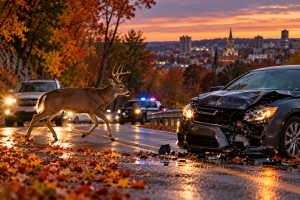
 Most people think of deer collisions as a rural problem, something that happens on back roads in farm country, not in and around a city like Worcester. That assumption is wrong, and it gets people hurt every single fall. Worcester County consistently ranks among the top counties in Massachusetts for deer-related car accidents, and the numbers behind that trend are more alarming than most drivers realize.
According to AAA Northeast, which analyzes Massachusetts Department of Transportation crash data annually, there were 1,569 deer crashes in Massachusetts from October to December 2024 alone, accounting for 44% of all deer crashes for the entire year. That works out to a deer-related collision occurring somewhere in Massachusetts once every 84 minutes during those three months. Worcester County recorded 270 deer crashes during that same October-through-December window, making it the single most deer-collision-prone county in the entire state.
If you were involved in a crash this fall involving a deer or any animal on a Worcester-area road, understanding your legal options is more important than most people know.
Why Autumn Is Prime Time for Deer Crashes
Deer mating season, known as the rut, runs roughly from October through December. During this period, deer are unusually active, covering far more ground than they normally would, and their movement patterns become erratic and unpredictable. A deer that would normally stay near the tree line begins crossing open roads repeatedly, often without warning, often in low-light conditions.
The timing of the rut overlaps almost perfectly with two other fall phenomena that create dangerous conditions for drivers. The days get shorter, which means more commuting happens in darkness or at dusk and dawn when deer are most active. And when Massachusetts clocks roll back in November, the evening rush hour shifts entirely into darkness, which AAA research shows dramatically increases crash frequency. From October to December, 79% of all deer-related crashes in Massachusetts occur outside of daylight hours.
Add to this the fact that deer-related crash data in Massachusetts has risen 51% over the last decade, with 3,559 deer collisions recorded statewide in 2024 compared to 2,354 in 2015, and you have a problem that is genuinely getting worse, not better.
What Happens When You Hit a Deer and It Causes a Crash
This is where many drivers are confused about their legal and insurance situation. If you swerve to avoid a deer and strike another vehicle or a fixed object, the situation is very different from simply hitting the animal directly. A single-vehicle collision with a deer is typically handled under your own comprehensive auto insurance coverage, if you carry it. But if the deer strike or swerve causes you to hit another car, or if another vehicle strikes you because of the sudden disruption in traffic, the personal injury analysis becomes more complex.
There are also situations where road conditions contributed to the severity of a deer-related crash in ways that may create additional liability. A poorly lit stretch of road without adequate wildlife warning signage in an area with known deer activity, or road construction that has altered the normal flow of traffic near a wooded area, can sometimes factor into a legal analysis of who bears responsibility for the full extent of the harm.
A personal injury lawyer in Worcester can evaluate the specific circumstances of your crash and tell you honestly what legal options exist. Not every deer crash produces a viable third-party claim, but many involve circumstances that are worth examining carefully.
The Physical Consequences Are Often Severe
People underestimate how physically dangerous deer collisions can be. A mature white-tailed deer in Massachusetts typically weighs between 130 and 200 pounds. At highway speed, striking an animal of that size produces an impact that can cause serious vehicle damage and significant occupant injuries. Airbag deployments, broken glass, and the violent deceleration of a sudden impact all create injury risks that go well beyond what a fender-bender produces.
When a driver swerves to avoid a deer and rolls the vehicle, or enters the opposing lane and strikes an oncoming car, the injury picture can be catastrophic. The Insurance Information Institute estimates the average cost of an animal-related crash at around $10,000, but that figure reflects property damage averages and does not begin to capture what serious physical injuries cost over weeks, months, or years of treatment and recovery.
If you were injured in a deer-related crash and your injuries are significant, the financial impact of not pursuing every available legal and insurance option can be severe. A Worcester personal injury attorney can make sure you understand what coverage applies and what claims are worth pursuing.
What to Do Right After a Deer Collision in Worcester
Pull safely off the road if you can. Do not approach a deer that has been struck. Injured deer are unpredictable and can cause additional harm. Call 911 and have the police document the scene. Your insurance company will want an official report.
Photograph the damage to your vehicle, the position of the deer if it is still present, the road conditions, and any relevant environmental factors like the absence of street lighting or wildlife crossing signage. If there were other vehicles involved in the incident, get their information and wait for police to arrive before leaving the scene.
Even if you feel physically okay in the immediate aftermath, get a medical evaluation. Crash injuries, including those from deer collisions, frequently produce delayed symptoms. Neck and back injuries, soft tissue damage, and concussions are all common outcomes from the sudden impact and reflexive swerving that deer crashes produce.
Contact a personal injury lawyer in Worcester to discuss the specifics of your situation. The consultation is free and gives you a clear picture of what, if anything, can be pursued beyond your own insurance claim. October through December is the most dangerous window for deer crashes in Worcester County every single year. If this fall has already put you in that situation, make sure you have the right guidance moving forward.