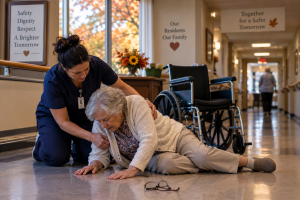
 Most families with a parent or grandparent in a Worcester nursing facility think about fall risk in the abstract. They know older adults fall. They know falls can be serious. What they often do not know is that autumn, specifically the September through November period, sees a measurable increase in falls and injuries within long-term care facilities, and that a significant portion of those incidents are preventable failures that facilities are legally required to address.
The reason autumn is particularly dangerous for nursing home residents involves several overlapping factors. Staffing disruptions that began during summer vacation schedules often continue into September as facilities struggle to refill positions. The change in natural light means residents who were accustomed to morning and evening routines with adequate ambient light suddenly experience those same routines in darkness, increasing disorientation and fall risk. Seasonal mood shifts affect residents with dementia and cognitive impairment in documented ways. And the physical transitions between summer and fall, including room temperature changes and altered outdoor activity schedules, disrupt the routines that provide structure and safety for vulnerable residents.
None of this is an excuse. It is a foreseeable pattern that facilities are professionally and legally obligated to anticipate and manage. When they fail to do that, and a resident gets hurt, families in Worcester have legal options.
The Scale of the Nursing Home Fall Problem in Massachusetts
Falls are the most common accident in nursing home settings nationwide. Research published in health policy journals estimates that between 50 and 75% of nursing home residents fall each year, with many experiencing multiple falls. Approximately 35% of fall injuries in nursing homes occur among residents who cannot walk. That figure alone tells you something important: many nursing home falls are not the result of a mobile resident making an independent decision to walk somewhere. They are the result of residents being inadequately monitored, inadequately assisted, or left in conditions that created a preventable fall risk.
In Massachusetts, the 2024 Executive Office of Elder Affairs assessment documented more than 55,000 allegations of elder abuse or neglect statewide. Falls resulting from inadequate supervision, inadequate use of fall-prevention protocols, or failure to use necessary mobility assistance equipment represent a significant portion of preventable harm in this category.
National Center on Elder Abuse data adds a particularly sobering dimension: studies have found that over 50% of nursing home staff members surveyed admitted to having mistreated a resident within the previous year. Mistreatment ranges from active abuse to neglectful behavior, and the fall that happens when a resident is left unattended too long in a position that creates fall risk is a form of neglect, even if no one intended harm.
What Nursing Homes Are Supposed to Do to Prevent Falls
Federal regulations under the Nursing Home Reform Act require nursing facilities to conduct fall risk assessments for every resident and to develop and implement individualized care plans that address identified fall risks. These are not suggestions. They are mandatory requirements with specific implementation standards.
A proper fall prevention plan for a high-risk resident might include bed and chair alarms, non-slip footwear, adequate lighting in the resident’s room and bathroom, regular toileting schedules to reduce nighttime mobility, physical therapy to maintain strength and balance, appropriate use of bed rails where indicated and clinically safe, and staff protocols for assisting residents who need help with mobility.
When a facility fails to conduct an adequate risk assessment, fails to implement a care plan, or implements a care plan on paper but does not follow it in practice, and a resident falls and is injured as a result, the facility has breached its duty of care under both Massachusetts law and federal nursing home regulations. That breach is the foundation of a personal injury claim.
The Injury Picture When a Nursing Home Resident Falls
Nursing home fall injuries are often catastrophic in ways that compound the tragedy of what already happens to aging bodies. Hip fractures are the most common serious outcome, and for elderly residents, a hip fracture frequently triggers a cascade of complications: surgery, hospitalization, post-surgical infection risk, pneumonia from immobility, delirium, and in far too many cases, a permanent decline in function that makes independent living impossible and significantly shortens the resident’s life.
Published research shows that up to 20% of hip fracture patients in nursing home settings die within one year of the fracture. That figure reflects both the severity of the injury itself and the vulnerability of the population. It also underscores why preventing these falls through adequate care is not just a regulatory requirement. It is a matter of whether a resident lives or dies.
When a Worcester nursing home’s failure to follow its own fall prevention protocols, or failure to develop one at all, results in a resident’s hip fracture, traumatic brain injury, or death, the family has a serious personal injury or wrongful death claim against the facility.
What Families Should Do When a Fall Happens
Request a complete copy of your family member’s medical records and care plan immediately after a fall. Request the facility’s incident report for the event. These are documents you are entitled to, and getting them quickly preserves information that facilities have an incentive to characterize in self-protective ways as time passes.
Photograph any visible injuries: bruises, lacerations, swelling. If your family member can communicate, ask them what they remember about how the fall happened and who was present. Document everything you observe about staffing levels and the conditions in the facility on the days around the fall.
Contact a personal injury lawyer in Worcester as soon as possible. Nursing home neglect cases involving falls require expert review of medical records and care documentation, and that work needs to begin promptly. A Worcester personal injury attorney who handles nursing home cases can investigate the facility’s compliance history, identify pattern failures, and build a case that holds them accountable for what happened to your family member.
Your loved one trusted that facility with their safety. Autumn should not be when that trust gets broken.