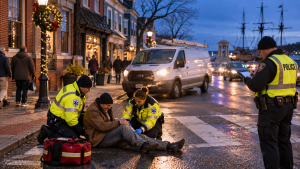
 On a Saturday in December of 2025, a little after 6:30 in the evening, a man was walking near 280 Court Street in Plymouth when a white work van hit him. The van kept going north on Route 3A toward Kingston. Police put out a description and a partial plate. A few days later they said they’d located the driver, and charges followed.
It’s one crash. It’s also a pretty ordinary one for this time of year. Early evening, already dark, a busy road, a person on foot. If you spend any time walking in Plymouth between November and March, you know exactly how that kind of evening feels.
A town built for 1620, a road built for 2026
Route 3A runs straight through downtown Plymouth. Court Street, Main Street, and Water Street all carry people who are in a hurry and people who are looking up at a building or checking a phone for directions. Sidewalks are narrow in places, crosswalks are spaced out, and the harbor is on one side while the historic district rises on the other.
The town itself seems well aware of it. A recent Plymouth planning document describes a downtown project focused on a 3,000-foot segment of Route 3A, with the stated goal of redesigning the streetscape to improve pedestrian safety and connectivity. A town mobility study has also looked at whether a one-way pair along Route 3A and Water Street would work better. I wouldn’t read any of that as an admission of anything. It isn’t. But it tells you that pedestrian safety downtown has been a real topic of conversation, and not just among people who’ve been hit.
Darkness comes early, and it matters
WalkMassachusetts, which analyzes MassDOT crash data, reported that nearly 70 percent of fatal pedestrian crashes in Massachusetts in 2025 happened in the dark. Seventeen percent involved a driver who left the scene. Those are statewide numbers, not Plymouth numbers, but there’s nothing about Plymouth that makes them less relevant. The sun sets before 4:30 in late November, and the Thanksgiving weekend crowds are walking back to cars and garages in full darkness.
That puts a real burden on drivers. A driver is expected to adjust to the conditions, not just the number on the speed limit sign. Low light, wet pavement, glare from oncoming headlights, and crowds in the road all call for slower speeds and sharper attention. A driver who says “I didn’t see him” in a crosswalk on a busy downtown street at dusk isn’t offering an excuse. They’re describing the problem.
If you’re a visitor, you can still pursue a claim from home
Plymouth gets people from everywhere, and a pedestrian crash doesn’t check where you live. It’s common for someone hit here to be a hundred or a thousand miles from home, with a hospital bill from a local emergency room, a rental car they can’t drive, and a flight they can’t take.
If that’s you, a few points are worth knowing.
Your claim arises from a Massachusetts crash, so Massachusetts law generally governs it, and the case would normally be handled here. You can usually hire a personal injury lawyer in Plymouth without traveling. Phone calls, video meetings, and electronic signatures cover a lot of ground. Your treatment can continue at home, and your lawyer can collect records from both places. Your health insurer may have a right to be repaid out of any recovery, so that’s something to raise early. And if the case doesn’t settle, there may be a point where you need to come back for a deposition or hearing, though most cases don’t get that far.
The one thing that doesn’t wait is the physical evidence. Cameras, witnesses, and the scene itself are all here, and you’re not. A local lawyer can do that part for you.
Crowds, detours, and road closures
Big events change how people move. Streets close, traffic gets diverted, and police or private detail officers direct pedestrians and cars. Usually it works. Occasionally it doesn’t, and someone ends up crossing where they shouldn’t or getting waved forward into a lane that still has cars in it.
If traffic control played a part in your crash, that’s worth looking into. Claims involving a town or its employees carry special notice rules and limits on damages, and the deadlines can be short. This is one of those situations where a quick call matters more than a perfect understanding of what happened.
Route 3 is a different problem
Every so often a pedestrian is hit on Route 3 itself. State police have responded to crashes where a person was struck on the highway in Plymouth and left in critical condition. Usually it involves someone who got out of a disabled car, or who was walking where nobody expects a person. Drivers still have to keep a lookout, but those cases raise sharper arguments about shared fault, and they’re not ones to try to figure out alone.
If the driver left
You may still be covered. In Massachusetts, personal injury protection generally follows the injured person, and uninsured motorist coverage can apply when the driver can’t be identified. Your own policy, or one belonging to a relative in your household, may be involved. Get the police report, and tell your insurer quickly.
What to do in the first few days
Get medical care first, and tell the doctor exactly how you were hurt. Photograph the scene, including lighting, crosswalk markings, and the sightline a driver would have had. Look for cameras on nearby storefronts and garages, write down which ones you see, and ask a lawyer to send preservation requests, since footage is often overwritten within days. Keep your clothing and shoes as they are. Don’t give a recorded statement to an insurer before you’ve had advice.
A pedestrian accident lawyer in Plymouth can take over the local legwork and walk you through the rest. The consultation is free, and a Plymouth personal injury attorney won’t charge a fee unless you recover compensation.