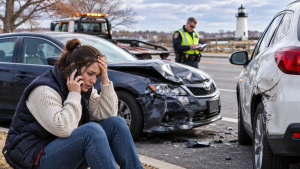
 Nobody budgets for the other driver having no insurance. You pay your premium, you drive carefully, and it seems reasonable to expect that anyone who hits you will have a policy to answer for it. Then a crash happens and the person who caused it has nothing, or drives away, or carries a policy so small it barely covers a week of treatment. In each case, your own insurance becomes the main character. A Plymouth uninsured motorist lawyer reads these policies with clients regularly, and the clearest way to explain them is to compare three different kinds of bad luck, one after another, using the state’s own description of what a Massachusetts auto policy includes.
Bad luck number one: the driver who stays
A man runs a red light on Route 44, hits a car, apologizes, hands over a name and later turns out to have no policy at all. The injured driver has medical bills and a damaged car and nobody to send them to.
The first source of help is personal injury protection. According to the state’s guide to what is in a Massachusetts auto policy, this coverage is built into every policy, and it pays for medical costs, replacement services and a share of lost pay, up to $8,000 per person. Because it does not wait for anyone to be found at fault, it can start paying even when the other driver is a dead end.
The second source is the coverage written for exactly this situation. Every policy includes a protection for injuries caused by an uninsured vehicle, and the state lists the minimum as $25,000 for one injured person and $50,000 across everyone hurt in the same crash. In practice, that means the injured driver turns to his or her own insurer to stand in for the missing one.
Bad luck number two: the driver who vanishes
Now change one detail. The other car leaves the scene, and nobody gets a plate. The state’s page says the same uninsured auto coverage reaches losses caused by an unidentified driver, including hit and run crashes. That is an important point, because many people assume that a driver who cannot be found means no claim at all.
The practical advice here is about proof. Call the police right away and ask that the report record that the other vehicle fled. Look for cameras, ask nearby businesses whether anything was recorded, and write down every detail you remember about the car, even partial ones. The less you know about the other driver, the more the surrounding evidence matters.
Bad luck number three: the driver with too little
The third situation is the sneakiest. The other driver has insurance, but the limits are low and the injuries are not. The same state page describes an optional coverage called underinsured motorist protection for this case, and it explains how it works with an example. Whatever you collect from the other driver’s insurer reduces what your own underinsured coverage will pay. With a $50,000 per person limit, collecting $25,000 from the other side means the most remaining is $25,000.
The word optional is the catch. Plenty of people never chose it, so the first step in a claim is checking the declarations page to see what was actually bought.
What your policy says about the limits you picked
That page also lists optional higher limits for bodily injury, such as $40,000 per person and $90,000 per accident, which can protect passengers in your own car and apply outside Massachusetts as well. The page also notes that the required minimums for bodily injury and property damage went up on July 1, 2025. Whether a client chose more than the minimum is one of the first things a Plymouth uninsured motorist lawyer checks, because that single figure can shape the whole claim.
What none of these coverages fix
Your car is a separate matter. Collision coverage, another optional choice, covers damage from striking another object whoever caused the crash, and the state’s page says it usually carries a $500 deductible. If you did not buy it, the repair bill may stay with you. The page also lists rental car coverage during repairs as an add-on you would have had to select ahead of time.
Proving the other driver was responsible
Being on your own policy does not remove the need to prove fault. Your insurer will want to know that the other driver caused the crash, and may ask hard questions about your speed, your lane or what you could have done differently. Fault is divided under G.L. c. 231, section 85, which says a person found more than half responsible cannot recover and a smaller share reduces the recovery by that share.
Steps worth taking in the first days
Get the police report and make sure it states that the other driver had no insurance or left the scene. Photograph the cars, the road and the intersection. See a doctor promptly and tell the provider how the crash happened. Tell your insurer soon and keep notes on every conversation, including names and dates. Gather witness contact details before they are lost.
Mistakes that cost people money
Waiting weeks to notify an insurer, giving a recorded statement without thinking it through, and assuming the claim against your own company will be simple are the most common errors. Another is never learning which optional coverages were purchased until after a crash. Reading your policy now, long before you need it, is the best protection.
Getting advice
If you were hurt by a driver with no insurance, one who fled or one with too little, a free consultation can help you understand which parts of your policy apply and how to start. Bring your declarations page, the police report, your medical records and any photographs you took.