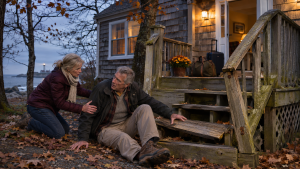
 You booked a place near the harbor for Thanksgiving weekend. A house, an apartment over a garage, a cottage the owner lists on one of the big rental sites. The photos looked great and the reviews were good. You arrived after dark on Friday, hauled in your bags, and started down the back steps to find the grill.
There were no lights on the steps. The third one was loose, and so was the railing. You went down hard.
Now you’re sitting in an urgent care waiting room, a long way from home, with a wrist that doesn’t look right and no idea who’s responsible. Is it the owner? The website? Do you even have a claim if you’re a guest in someone’s house?
You do, and there’s a rule most people have never heard about that makes it much more likely that someone’s insurance will be there to pay.
What Massachusetts requires of short-term rental hosts
In 2018, Massachusetts passed a law regulating short-term rentals, which took effect on July 1, 2019. Among other things, it requires anyone renting out a property for short stays to maintain at least $1 million in liability insurance for each rental. That coverage has to defend and protect the host against claims for bodily injury and property damage arising from the rental. If the property is listed through a platform like Airbnb or Vrbo that provides coverage at least that large, the platform’s insurance can count. Hosts are also required to tell their own homeowner’s insurer that they’re renting the place out.
Why does it matter to you? Because the state’s own Division of Insurance has warned that an ordinary homeowner’s or renter’s policy typically won’t cover injuries to paying short-term guests. The law was written to close that gap. A guest who falls down the stairs in a Massachusetts rental shouldn’t be left with a hospital bill and a shrug.
The same law requires working smoke and carbon monoxide alarms in short-term rentals. Not every claim is about stairs.
Who can be responsible
The owner or operator of the property is the usual target. A host has a duty to use reasonable care to keep the premises safe for guests, and that includes things like adequate lighting, sound railings, stable steps, and working locks on the doors that lead to hazards.
A property manager can share that responsibility. Many Plymouth rentals, especially seasonal and second homes, are run by a management company that handles cleaning, repairs, and check-ins. If the manager knew about a problem and didn’t fix it, or took over maintenance and did it poorly, they may be liable too.
The booking platform is trickier. Platforms generally present themselves as a marketplace, not a landlord, and their terms of service can limit how you bring claims against the company itself. That doesn’t necessarily affect your right to pursue the host and the host’s insurance. It’s the kind of detail a lawyer should read for you before you click anything or sign anything the platform sends.
What typically goes wrong
The hazards are not exotic. Exterior stairs with no light. Handrails that wobble. Decks that stay wet or frosty in shade. Uneven brick or stone on a path from the driveway. Slick tile in a bathroom or entryway. Steep, narrow basement or loft stairs with no rail. A rental that has been closed up for part of the year and quietly got worse.
Fall and winter add their own trouble. It gets dark earlier, so the walk from the car at 5:15 is a walk in the dark. Wet leaves pile up on steps. Frost forms on boards before anyone’s thought to salt them. A property that is fine in July can be hazardous in November, and a responsible host knows that.
The question that decides most cases
It usually comes down to what the owner knew. Did they know the step was loose? Had another guest complained? Does a review from last spring say “watch the back stairs, they’re really dark”? Is there a text message thread where somebody mentioned the railing?
That kind of record is easy to lose. Listings get edited, reviews get hidden, messages scroll out of view. If you can, take screenshots of the listing (the description, photos, and reviews), your booking confirmation, and every message with the host before anything changes. Photograph the spot where you fell, including lighting and the condition of the step, rail, or surface, and do it as soon as you safely can. If the host sends someone to fix it, you’ll want your pictures from before.
“But I signed something”
Rental terms often include language saying guests assume the risk of staying there. It’s reasonable to worry about it. But a clause like that isn’t automatically the end of the story, particularly when the problem was a known hazard the host should have fixed. Whether it applies depends on the exact wording and the circumstances, so don’t assume it blocks your claim before someone has read it.
Hotels and inns, and what’s different about a lease
The same basic rules apply if you were staying at a hotel, a bed and breakfast, or an inn. If you rent a home on a year-long lease, though, a different body of landlord and tenant law governs the relationship. This article is about short stays.
What to do now
Get medical care and be specific about how you were hurt. Report the fall to the host in writing, even if it’s just a text, and ask for the name of their insurance carrier. Keep every bill and receipt, including the ones for travel changes. Don’t give a recorded statement to an insurer, and don’t sign a release, before you’ve talked to someone.
A personal injury lawyer in Plymouth can find out what coverage exists, send the host’s insurer a notice, and make sure the evidence doesn’t disappear. If you live out of state, most of that can be done remotely. The consultation is free, and a Plymouth personal injury attorney won’t charge a fee unless the claim recovers money.