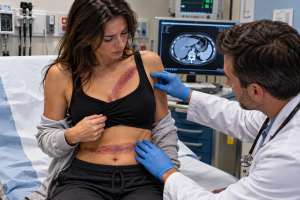
 You were wearing your seat belt when the crash happened. That is the right thing to do, and in a serious collision, your seat belt almost certainly prevented injuries far worse than the ones you are now dealing with. But the seat belt itself, doing exactly what it was designed to do, can cause a distinctive pattern of injury that often gets dismissed, both by crash victims who feel they should be grateful it was not worse and by insurance companies looking for reasons to minimize what they owe.
Seat belt syndrome is the term medical professionals use to describe the constellation of injuries produced by the restraint forces of a seat belt during a significant crash. The diagonal shoulder belt and the lap belt across the lower abdomen absorb the kinetic energy of your body moving forward into the crash, and that absorption produces forces on your chest, abdomen, and spine that can cause real and serious harm. The bruising pattern it leaves, a diagonal band across the chest and a horizontal mark across the lower abdomen, is one of the clearest physical signs that significant forces were transmitted through the restraint system to your body’s internal structures.
If you walked away from a Worcester car accident with that bruise, your body is trying to tell you something. And so is your attorney.
What Seat Belt Syndrome Can Actually Involve
The visible bruising from seat belt syndrome is only the surface manifestation of what may be happening underneath. The structures that the seat belt presses against during a crash are not just skin and muscle. They include the sternum, the ribs, the clavicle, the thoracic and lumbar spine, and an array of abdominal organs including the liver, spleen, intestines, mesentery, and the abdominal aorta.
Rib and sternal fractures are among the most common seat belt syndrome injuries. A cracked rib is extraordinarily painful and limits breathing, sleeping, and movement for weeks. Multiple rib fractures or sternal fractures can compromise respiratory function and, in more severe cases, require medical intervention. Pneumothorax, or a collapsed lung caused by a rib puncturing lung tissue, is a potentially life-threatening complication that emergency physicians specifically watch for in patients presenting with seat belt bruising after a significant crash.
Abdominal injuries are where seat belt syndrome gets most dangerous. Liver lacerations, spleen injuries, and intestinal or mesenteric tears caused by lap belt forces can produce internal bleeding that is not immediately obvious in the minutes or hours after an accident. A patient who walks away from a crash feeling sore but relatively okay can deteriorate dramatically over the following hours as internal hemorrhage progresses. This is one of the reasons emergency physicians take seat belt bruising seriously as a clinical sign: it indicates that significant force was applied to structures that can fail silently in the immediate aftermath of a collision.
Lumbar spine injuries, including fractures of the vertebral bodies in the lower back, are also associated with seat belt syndrome, particularly when the lap belt rises above the pelvis during a crash, a phenomenon called seat belt submarining that applies direct compressive force to the lumbar region.
Why These Injuries Get Undervalued in Personal Injury Claims
Seat belt syndrome injuries create a specific vulnerability in the personal injury claims process that insurance companies exploit through a predictable line of argument. The argument goes like this: the crash caused the seat belt to injure you, not the other driver’s negligence directly. The seat belt was doing what it was supposed to do. Therefore, the injuries are somehow less attributable to the negligent driver.
This argument is legally wrong, and any competent personal injury lawyer in Worcester will dismantle it quickly. The cause of the crash is the at-fault driver’s negligence. The crash created the forces that the seat belt had to restrain. The seat belt injuries are a direct consequence of those crash forces, and they are fully compensable as damages caused by the at-fault driver’s negligence. The fact that the seat belt prevented worse harm does not reduce the compensation available for the harm it did cause.
A related minimization tactic is to focus exclusively on what imaging shows and dismiss what it does not. Seat belt syndrome injuries sometimes appear on CT scans and sometimes do not, particularly in the immediate post-crash period before internal injuries have fully declared themselves. A crash victim who presents to the emergency room with seat belt bruising and a normal initial CT may be sent home, only to return hours later with significantly worse symptoms as an internal injury becomes clinically evident. The documented trajectory of these injuries, when properly presented, is itself evidence of the severity of the crash forces involved.
The Connection Between Seat Belt Injuries and Serious Settlement Values
Published Massachusetts verdict data includes settlements and awards in the mid-six-figure range for serious seat belt syndrome cases involving internal organ injury, significant spinal fractures, and cases requiring surgical intervention. The value of any individual case depends on the specific injuries, the treatment required, the impact on the victim’s work and daily life, and the quality of the documentation and legal representation.
What is consistent across these cases is that they require medical experts who can explain to a jury or an insurance negotiator exactly how the crash forces produced the injury, why those forces are attributable to the at-fault driver’s conduct, and what the long-term consequences of the injuries are. This is precisely the kind of expert-supported, thoroughly documented case that a personal injury lawyer in Worcester builds over the course of the claims process.
If You Have a Seat Belt Bruise After a Worcester Accident
Tell every medical provider who examines you about the bruise and its location. Accept any recommendation for CT imaging, observation, or specialist follow-up. Do not dismiss symptoms that develop in the hours or days after the crash as ordinary post-accident soreness without medical evaluation. Internal injuries that become symptomatic after an initial discharge from the emergency room are a medical emergency.
Contact a personal injury lawyer in Worcester as soon as your immediate medical situation is stable. The bruise across your chest is evidence. The forces that created it are evidence. Everything that happened to your body because of those forces is compensable, and making sure the full value of your claim is recognized requires experienced legal representation from the beginning.