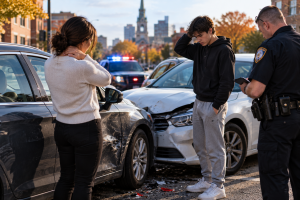
 Every year in Worcester, drivers, cyclists, and pedestrians are hurt by teenage drivers making the kinds of errors that inexperienced drivers make: misjudging a gap in traffic, failing to check blind spots properly, following too closely, reacting too slowly to a changing situation, or simply making the overconfident decisions that come with having a license and not yet having enough road experience to know what you do not know yet.
Being hurt by a teenage driver raises questions that do not come up in most car accident situations. A sixteen-year-old with a newly minted license probably does not own the car they were driving. They almost certainly do not have a personal injury settlement fund in their name. They may not even have a job. So when the police report comes back and the at-fault driver turns out to be a minor, it is natural to wonder: is there any realistic path to compensation here, or is this a dead end?
It is not a dead end. In most cases, it is actually not meaningfully different from any other car accident claim. Here is why.
The Insurance Policy on the Car Is What Matters First
In the overwhelming majority of teen driver accident cases, the vehicle the teenager was driving is insured under a policy that either covers the teen directly or covers any permissive user of the vehicle, which includes a licensed minor who had the owner’s permission to drive. If the teenager was driving a family vehicle covered under their parents’ auto insurance policy, that policy is the primary source of compensation for anyone the teen injures.
Massachusetts requires drivers to carry liability insurance, and that requirement extends to vehicles operated by insured household members, including teenage drivers who are listed on the policy. The liability limits on the policy, whatever they are, are available to compensate you for your injuries when a covered driver causes a crash. Your claim is fundamentally against that policy, not against the teenager’s nonexistent personal assets.
A personal injury lawyer in Worcester will identify the applicable insurance policy, confirm the coverage available, and pursue your claim against that coverage just as they would in any other auto accident case.
When Parents Bear Personal Liability
Beyond the insurance policy, Massachusetts recognizes circumstances under which the parents of a minor driver can bear personal legal liability for accidents caused by their child. The two most significant doctrines are negligent entrustment and the family car doctrine.
Negligent entrustment applies when a parent allows a minor to operate a vehicle despite knowing, or having reason to know, that the minor was incompetent, inexperienced beyond what their licensing stage reflects, or posed a risk of harm to others. A parent who gives car keys to a teenager who has recently demonstrated seriously dangerous driving behavior, who does not yet have a valid license, or who is in a clearly impaired state has potentially committed negligent entrustment. When those circumstances can be established, the parent faces personal liability beyond what the insurance policy provides.
The family car doctrine, recognized in various forms across multiple states, holds that when a family vehicle is made generally available for family use and a minor family member drives it with the implied permission of the owner, the vehicle owner’s liability extends to cover the minor’s negligence. Massachusetts courts have addressed this doctrine in ways that make it worth exploring in appropriate cases, particularly when the liability limits of the existing policy are inadequate to cover serious injuries.
When the Teen Was Driving Someone Else’s Car
If the teenager who hit you was driving a vehicle that belongs to a friend, an employer, or anyone other than their parent, the coverage analysis involves the owner of that vehicle’s insurance policy. Most auto insurance policies cover permissive users of the insured vehicle, and if the teenager had the owner’s permission to drive, that policy is generally the applicable coverage.
The question of whether the teen had permission matters. A teenager who borrowed a friend’s car without asking, or who was driving their employer’s vehicle outside the scope of their work duties, may not qualify as a covered permissive user. These factual questions require investigation, and a Worcester personal injury attorney will work through them systematically to identify every available source of coverage.
Massachusetts Statistics on Teen Driver Accidents
The risk profile of teenage drivers is well documented nationally and reflects on Massachusetts roads as well. Per mile driven, teen drivers ages 16 to 19 are nearly three times more likely to be in a fatal crash than drivers 20 and older, according to the CDC. The first year of independent driving is the highest-risk period. Massachusetts graduated licensing laws were designed to reduce this risk by limiting nighttime driving and passenger restrictions for new drivers, but the data shows that inexperienced drivers remain a disproportionate source of accidents even under these restrictions.
Your Case Is Probably Stronger Than It Feels
Many people who are hurt by a teenage driver in Worcester feel defeated before they even start, assuming that the youth of the at-fault driver means there is nothing to pursue. That feeling is almost always wrong. The insurance coverage that applies to most teen driver accidents is the same coverage that applies to any other auto accident, and the personal injury claim process is the same.
Contact a personal injury lawyer in Worcester and let them evaluate the specific situation. The consultation is free, the coverage analysis is something an experienced attorney can complete quickly, and in most cases the path forward is clearer and more promising than it initially seemed.