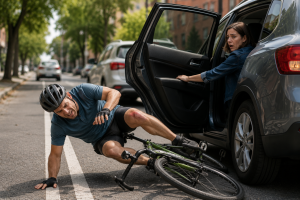
 It happens in a fraction of a second. You are riding your bike along a Worcester street, moving at a normal pace, and a parked car door swings open directly in front of you. There is no time to react. You hit the door, go over the handlebars, and land on the pavement.
Dooring accidents look straightforward at first. Someone opened a door without checking. You got hurt. Open and shut, so to speak. But the legal reality of these crashes is more layered than most people expect, and the details of how they are handled can significantly affect how much compensation an injured cyclist actually recovers.
Who Can Actually Be Held Responsible
The most obvious defendant in a dooring accident is the person who opened the door. Under Massachusetts law, it is illegal to open a vehicle door into the path of traffic without first checking that it is safe to do so. When someone violates that rule and a cyclist is hurt, they carry liability.
But depending on the circumstances, other parties may share responsibility.
If the door was opened by a passenger rather than the driver, the passenger can be liable independently. If it was a delivery vehicle and an employee opened the door while making a delivery, the company employing that driver may be liable as well. If the accident happened because the city’s bike lane design forced cyclists into the door zone of parked cars with no adequate buffer, there is an argument, though a more difficult one, that the municipality bears some responsibility for a design that creates predictable danger.
A Worcester personal injury attorney will look at all of these angles, because identifying every responsible party is how you make sure you are not leaving compensation unclaimed.
The Door Zone Problem in Worcester
Most cyclists who ride regularly in cities develop a habit called taking the lane or riding outside the door zone, which means staying far enough from parked cars that an opening door cannot reach them. This habit exists because experienced cyclists know exactly how dangerous parked car doors are.
But Worcester streets do not always make this easy. Bike lanes that run directly adjacent to parking without a buffer put cyclists in the door zone by design. Narrow streets where taking the lane creates conflict with motor vehicle traffic force uncomfortable tradeoffs. And cyclists who are newer to urban riding may not yet have the defensive instincts that experienced riders develop.
When a dooring accident happens in a location where the road design put the cyclist in danger, the conversation about liability broadens. It does not necessarily excuse the person who opened the door, but it adds context that matters for understanding the full picture.
The Crash That Happens After the Door
One aspect of dooring accidents that often gets overlooked is what happens after initial contact with the door. A cyclist thrown from their bike into the street may be struck by a moving vehicle. In busy Worcester traffic, especially on arterials like Park Avenue or Main Street, a cyclist on the ground is at serious risk from vehicles that have no warning.
If a moving vehicle strikes the cyclist after the dooring, the driver of that vehicle may also carry liability depending on whether they had adequate time and distance to stop. Dooring accidents can involve multiple insurance claims across multiple parties, which is exactly the kind of complexity that benefits from legal representation from the start.
Summer Riding and the Delivery Vehicle Problem
Summer brings more delivery vehicles to Worcester streets. Restaurant deliveries, package deliveries, grocery services, all of them involve drivers stopping at the curb and opening doors repeatedly throughout the day. A delivery driver making their fifteenth stop of a busy summer afternoon may be moving quickly, not checking mirrors as carefully as they should, and creating door hazards every few minutes.
When a delivery vehicle causes a dooring accident, the injured cyclist may have a claim against both the driver and the company they work for. If the driver is an employee rather than an independent contractor, the company’s liability insurance becomes involved. These corporate claims are typically larger and more contested than individual driver claims, which is another reason having a personal injury lawyer in Worcester handle negotiations matters.
What Cyclists Can Do to Protect a Future Claim
After a dooring accident, the same rules apply as any other crash. Call the police. Get a report filed. Get the name and insurance information of the driver or passenger who opened the door. Take photographs of the door, the bicycle, the street, and your injuries.
Get medical attention that day. Dooring accidents produce impact injuries including wrist and hand fractures from catching yourself on the pavement, shoulder injuries, head trauma, and facial injuries from going over the handlebars. These injuries need documentation from the same day.
Note whether there were any witnesses. Bystanders who saw what happened are valuable, and they are most accessible in the immediate aftermath of the crash.
If a Worcester personal injury attorney is involved early, they can also look at whether any surveillance cameras in the area captured the accident. Dooring incidents that happen near businesses, restaurants, or intersections with traffic cameras sometimes have footage that provides clear evidence of exactly what occurred.