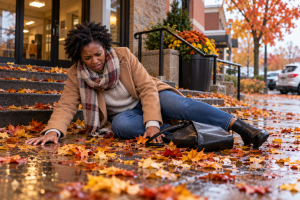
 Nobody warns you about wet leaves the way they warn you about ice. There are no public service announcements. Your car insurance agent does not send an autumn reminder. Businesses do not put up “caution: slippery leaves” signs the way they put up “wet floor” cones. And yet, a thick mat of wet fallen leaves on a sidewalk, parking lot, or entrance path can have a surface friction coefficient that rivals black ice on asphalt. When you step on it unexpectedly, particularly if you are moving quickly, carrying something, or navigating a step or curb, the results can be just as serious as any winter slip and fall.
In Worcester this autumn, wet leaves are everywhere. The city’s mature tree canopy is one of its genuine charms, but it means that sidewalks outside businesses, apartment buildings, commercial properties, and public spaces accumulate heavy leaf cover with every rain and every wind. Property owners in Massachusetts have a legal obligation to address this. Many of them do not, at least not with any urgency. And people get hurt as a result.
What Massachusetts Law Says About Wet Leaves
This is one of those areas where Massachusetts law is actually quite clear, even if most people do not know it. Under Massachusetts premises liability standards, property owners are responsible for clearing natural accumulations of hazardous material from their walkways and entrances in a reasonable time. This includes not just snow and ice but also leaf accumulation that creates slip and fall risks.
Worcester attorneys who specialize in slip and fall cases note that Massachusetts courts have explicitly addressed this. Unlike the old “natural accumulation” doctrine that historically protected property owners from liability for conditions created by weather, Massachusetts law now holds that property owners must take reasonable steps to address foreseeable hazards, and a sidewalk buried under wet leaves after a rainy autumn week is exactly the kind of foreseeable hazard that owners of commercial properties and apartment buildings are expected to manage.
If you slipped and fell on wet leaves on someone else’s property this fall in Worcester, the fact that the leaves came from a tree rather than from a leaky cooler does not necessarily shield the property owner from liability. A personal injury lawyer in Worcester can evaluate whether the specific circumstances of your fall support a premises liability claim.
The Injuries Are Exactly As Serious As Any Other Fall
People sometimes feel embarrassed about slip and fall injuries, as though getting hurt by something as seasonal and ordinary as leaves is somehow less legitimate than getting hurt in a more dramatic way. That perception is wrong, and it should not stop anyone from getting the help they need.
A fall on wet leaves produces the same kinds of injuries as any other sudden, uncontrolled fall onto a hard surface. Wrist fractures are extremely common, the result of instinctively reaching out to catch yourself. Hip fractures, which are particularly serious for older adults and can require surgery and months of rehabilitation, occur when the impact goes to the hip rather than the hands. Back and spine injuries, including herniated discs, happen when the fall involves a twist or when the impact is taken on the lower back. Head injuries, including concussions and traumatic brain injuries, occur when the head strikes the ground or a nearby object.
These injuries are not minor inconveniences. They require medical treatment, often including imaging, specialist evaluation, and sometimes surgery. They produce lost wages while you recover. They cause pain and disruption that can last weeks, months, or longer. All of this is compensable through a personal injury claim when a property owner’s failure to maintain their premises caused your fall.
Common Worcester Locations Where This Happens
Apartment building entrances and exterior staircases are among the highest-risk locations. Multi-family residential properties in Worcester often have exterior stairs and walkways that receive heavy leaf accumulation and are not always maintained on a timely basis. When a tenant or visitor slips on a leaf-covered exterior stair, the building owner or property management company may well bear liability.
Commercial properties with large parking lots and pedestrian pathways, including strip malls, grocery stores, and restaurant complexes throughout Worcester, often have areas where autumn leaves accumulate between maintenance cycles. The path from the parking lot to the entrance of a store can become genuinely treacherous after a rainy day in October or November without anyone having done anything obviously wrong.
Public sidewalks maintained by the City of Worcester present a different legal situation. Claims against municipalities in Massachusetts require following specific procedures, including a presentment requirement under Massachusetts General Laws Chapter 258, with shorter timelines than standard personal injury claims. If you were hurt on a city-maintained sidewalk, talking to a Worcester personal injury attorney quickly is especially important.
Documenting Your Fall: What to Do in the Moment
If you fall on wet leaves on someone else’s property in Worcester, photograph the scene before anything changes. Leaf cover gets cleared. Rain washes surfaces. The exact condition that caused your fall can disappear within hours. A photograph taken at the scene, ideally with a timestamp, showing the depth and condition of the leaf cover, the location, and any relevant features of the property, is often the most important piece of evidence in your case.
Report the fall to the property owner, manager, or business on the same day if possible. Make sure there is a written incident report and that you get a copy. Seek medical attention promptly and tell your provider exactly what happened and what you landed on. Then contact a personal injury lawyer in Worcester before speaking with the property owner’s insurance company.
The season is short. The hazard is real. And in Massachusetts, property owners who ignore it are legally accountable when someone gets hurt because of it.