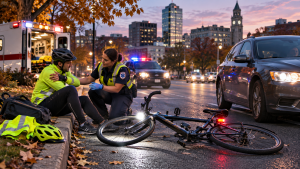
 If you bike to work in Worcester, November changes the math. The morning ride is fine, but by the time you head home, the light’s gone. Cars have their headlights on and you’re a small moving target at the edge of the lane.
A Worcester bicycle accident lawyer sees what happens when that goes wrong, and one of the first questions after a crash is nearly always the same: did you have lights? Here is what the published data and the rules say.
What NHTSA says about cyclists and darkness
NHTSA’s “Bicyclists and Other Cyclists: 2023 Data” reports that 1,166 pedalcyclists died in U.S. traffic crashes in 2023, which was 2.9 percent of all traffic fatalities and a 4 percent increase from 1,117 in 2022. About 53 percent of those deaths occurred in the dark, compared with 42 percent in daylight, and 81 percent happened in urban areas. In the fall, the most common time was between 6 and 8:59 p.m., accounting for 23 percent of deaths that season.
Those are national numbers, not Worcester ones. They do show that evening hours and city streets are where much of the danger sits.
What Worcester’s own report says
The city’s Vision Zero annual report for 2026 says that over the past decade, the share of bicyclist crashes that resulted in fatal or serious injury rose by 40 percent. For 2023 through 2025, bicyclists made up 6 percent of fatal and serious injuries. In 2025, it adds, bicyclists and pedestrians each had more serious or fatal injuries than at any other point in the past decade. The report doesn’t give the number of cyclists killed or seriously injured each year, so I won’t guess one.
What Massachusetts requires at night
The City of Cambridge’s bicycle rules page, summarizing state law, says Massachusetts requires bicyclists to use a white front light from 30 minutes after sunset to 30 minutes before sunrise, plus a red rear light or reflector, along with reflectors on the pedals or reflective material on the rider’s ankles. It also says state law requires anyone 16 or younger riding a bicycle to wear a helmet. That page points to G.L. c. 85, section 11B.
Why does that matter for a claim? Because lights are the first thing an insurer will ask about. If you had them, say so and show them. If you didn’t, it doesn’t automatically end your case, but it gives the other side an argument.
How shared blame works
Under G.L. c. 231, section 85, being partly at fault doesn’t automatically bar your recovery in Massachusetts, so long as your negligence wasn’t greater than the total negligence of the party you’re claiming against. Your damages are reduced in proportion to your share.
So the details matter. Where were you riding? Were you visible? Did the driver pass too close, open a door, turn across your path? A Worcester bicycle accident lawyer will try to build a clear picture of each of those.
What to do after a crash
Get medical care first. Cyclists often have wrist, shoulder, collarbone and head injuries that need prompt attention. Then:
- Call the police and make sure a report is filed, even if the driver says it was minor.
- Photograph the scene, the vehicle, your bike and your lights, if they were working.
- Keep your helmet and clothing, and don’t repair or discard the bike yet.
- Get names and numbers for any witnesses.
Bike shops can help later with an itemized damage estimate, which is often a part of the claim.
If you track your rides with a phone or bike computer, save that data too. The time, route and speed can back up your account of where you were and how you were riding, and it’s easy to lose if the device is replaced or the app deletes old rides. Take a screenshot of the ride and keep the original file as well.
Making yourself easier to see
Lights are the legal baseline, not the whole answer. Many riders add reflective ankle bands, a bright jacket or vest, and a light on the helmet or backpack, so that drivers see movement from more than one angle. A flashing rear light can help in traffic, while a steady one can be easier to judge for distance, and plenty of people use both. Replace batteries before they fade, because dim lights are the ones people don’t notice are failing. None of this shifts responsibility from a driver who isn’t paying attention, but it can make a real difference in whether you’re noticed at all.
Talking to insurers
Adjusters sometimes ask questions designed to show the rider was at fault, such as “Where exactly were you in the lane?” or “Did you see the car coming?” You don’t have to answer those on the spot. Take time, get your records together and get advice.
If you were hit while riding in Worcester, a Worcester bicycle accident lawyer can review what happened and explain what a claim might involve. It’s worth making that call before an insurer decides how the story gets told.