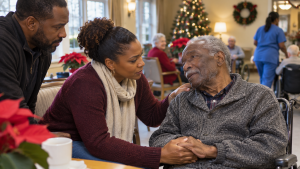
 For a lot of families, the holidays are one of the few times everyone shows up. The cousins who live far away come in, someone brings a pie to the nursing home, and for an afternoon the relative you’ve been worried about is surrounded by people who love them.
That’s also when people see changes they’ve missed. Maybe your mother seems thinner. Maybe your father flinches when an aide walks in. A Worcester nursing home abuse lawyer hears these stories every year. This article won’t tell you something terrible is happening, because most of the time it isn’t. It will tell you what’s worth noticing, what the public record says about staffing in Massachusetts, and where to take a concern.
What the staffing record shows
In July 2026, The New Bedford Light published an investigation into nursing home staffing. It found that 51 percent of Massachusetts nursing homes, which it counted as half of the state’s 341, failed to meet one or both state minimum staffing standards at the end of 2025. About 34 percent missed the overall nursing staff standard, 32 percent missed the registered nurse standard, and 14 percent missed both.
Those standards are set in state regulation 105 CMR 15000. The overall requirement is 3.58 hours of care per patient per day from nurses and nurse aides combined, and registered nurses must provide at least 0.508 hours per patient day of that total.
The article also reported that the state penalty for missing the overall ratio is a Medicaid rate cut, that the registered nurse standard isn’t enforced (“The state doesn’t enforce that standard at all”), and that inspectors cited only 31 nursing homes for inadequate staffing since 2024, even though 251 were below state minimums over that time.
Two limits are important. These are statewide figures, not figures for any one Worcester facility. And being understaffed on paper isn’t the same as proof that a specific resident was neglected. It’s context, not a verdict.
Why paperwork can understate what happens
A National Institute of Justice article on the extent of elder abuse notes that there’s no uniform reporting system for elder abuse in the United States, which makes administrative data unreliable for national estimates. In one nursing home study it describes, direct service staff reported more resident-to-resident incidents than the facility’s accident and incident reports or charts captured, which the researchers tied to documentation gaps.
The practical lesson: if something seems wrong, your own notes may matter more than what’s in the chart.
What to look for during a visit
None of these prove neglect or abuse by themselves. Together, or when they keep happening, they’re worth taking seriously.
- Injuries you can’t get a clear explanation for, such as bruises, cuts or a fall nobody told you about.
- Weight loss, dry lips, confusion or a loved one who always seems hungry or thirsty.
- Sores that don’t seem to be treated.
- Unclean clothing or bedding, or a room that isn’t being cared for.
- Call lights that go unanswered for a long time.
- A resident who becomes withdrawn, fearful or reluctant to be alone with a certain person.
- Medication changes you weren’t told about.
Write down what you see, with dates and times. Take photos of anything physical, with your relative’s consent when possible. Ask for the care plan and ask who to speak with about the concern.
Where to report
The Massachusetts website for health data lists the Department of Public Health at 800-462-5540 as the place to report suspected abuse of a person in a nursing home or hospital. If your relative is in immediate danger, call 911 first.
Keep asking questions after the holiday
A single visit rarely tells the whole story, so try to build a pattern over time. Visit at different hours when you can, since care at 2 p.m. on a weekday may look different from care on a weekend evening. Keep a notebook with dates, what you saw and who you spoke with. Ask politely for a meeting about your relative’s care plan and bring your questions in writing. Many concerns get resolved this way. If you raise something and nothing changes, or you feel brushed off, that’s useful information too, and it’s worth writing down.
Where a lawyer fits
A report to the state is one track. A civil claim is another, and the two don’t depend on each other. A Worcester nursing home abuse lawyer can request medical records and facility documents, look at whether the care your relative received met a reasonable standard, and tell you honestly whether there’s a claim. Some harm is simply the result of frailty, and a good lawyer will say so.
If you have a gut feeling after this week’s visit, trust it enough to write things down and ask questions. A Worcester nursing home abuse lawyer can help you figure out the next step.