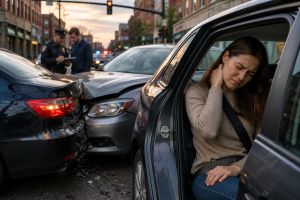
 Picture this. You ordered a Lyft on a Friday evening in Worcester. You got in, buckled up, and were scrolling on your phone when the car jolted forward violently. Another driver had rear-ended you at a red light on Main Street. Your neck snapped back. Your head hit the headrest hard. You did not cause this. You were not driving. You had nothing to do with what just happened. You are about as innocent as a person can be in a car accident situation.
And yet, in the hours and days that follow, you may find yourself caught between multiple insurance companies, none of whom seem particularly eager to step up and pay for what happened to you. Your Lyft driver’s insurer. The other driver’s insurer. Lyft’s corporate insurance. Your own health insurance. Everyone has a reason why it should be someone else’s problem.
This is one of the most frustrating and least talked about situations in personal injury law, and it happens to passengers in Worcester more often than most people realize. Here is what is actually going on, and what you can do about it.
Why Being an Innocent Passenger Does Not Make This Simple
You would think that being the person with zero fault in a collision would make your claim straightforward. You did nothing wrong. You have injuries. Someone caused those injuries. Pay up. But the reality of how rideshare insurance works creates a situation where multiple parties with competing financial interests all have a hand in what you ultimately receive, and none of them are on your side by default.
When your rideshare vehicle is struck by another driver, there are potentially two at-fault parties whose insurance could be in play: the driver who hit your vehicle, and the rideshare driver if their own actions contributed in any way to the crash. There is also the question of Lyft or Uber’s corporate liability coverage, which provides up to $1 million in coverage when a passenger is in the vehicle. And there is the possibility that your own uninsured or underinsured motorist coverage, if you have it on your personal auto policy, becomes relevant if the at-fault driver does not have adequate insurance.
That is a lot of moving pieces. And every one of those insurers has an adjuster whose job is to minimize what their company pays out.
The Other Driver’s Insurance: Where You Start
In a rear-end crash where another driver hit your rideshare vehicle, the most direct path to compensation is typically through that driver’s liability insurance. They caused the accident. Their coverage should respond. In a clean rear-end situation with no complicating factors, liability is usually not difficult to establish. The driver behind you has a duty to maintain a safe following distance and to be paying attention. If they rear-ended a stopped or slowing vehicle, that is almost always on them.
The problem is that Massachusetts minimum auto insurance requirements are not generous. A driver carrying only the state minimum coverage may not have nearly enough to cover a serious injury sustained in a high-impact crash. If your medical bills, lost wages, and pain and suffering exceed what that driver’s policy covers, you need to look elsewhere to make up the difference.
Lyft and Uber’s $1 Million Coverage: What It Actually Covers
Here is the piece that most passengers do not know about until they are already in the middle of a claim. When you are a paying passenger in an active Lyft or Uber trip, the rideshare company’s commercial insurance policy, which provides up to $1 million in liability coverage, is active. This coverage can step in when the other driver’s policy is insufficient to cover your damages.
But accessing this coverage is not as simple as calling Lyft and asking for a check. The rideshare company’s insurer will investigate. They will look at whether their driver bore any contributory responsibility. They will examine the circumstances of the crash. They will evaluate your injuries and your claimed damages. And they will make an offer that reflects their financial interests, not yours.
A personal injury lawyer in Worcester who has worked with rideshare claims knows how to navigate this process. They know how to document your injuries properly, how to push back against lowball evaluations, and how to use the full weight of that $1 million policy to get you what you actually deserve rather than what the insurer feels like offering.
What Happens When the Insurers Start Pointing at Each Other
This is the part that genuinely surprises people. You might reasonably assume that with multiple insurance policies in play, at least one of them will step up quickly and handle your claim. What actually tends to happen is that insurers start positioning themselves to minimize their own exposure, sometimes by suggesting that another insurer should be primary.
The other driver’s insurer may argue their policy limits are not enough and push toward Lyft’s coverage. Lyft’s insurer may argue that the other driver is fully responsible and their policy should cover everything. If your injuries required treatment that your health insurance paid for, your health insurer may have a subrogation interest in any settlement you receive, meaning they want to be reimbursed out of your recovery. Meanwhile, you are sitting there with a hurt neck, missed work, and a stack of medical bills, watching companies negotiate over who owes you what.
Having a Worcester personal injury attorney cuts through this dynamic immediately. Your attorney represents your interests and only your interests. They communicate with all of the insurers on your behalf, they know the legal leverage points that move these negotiations forward, and they make sure that the finger-pointing between carriers does not result in you being squeezed out of a fair recovery.
The Injury Picture in Rear-End Crashes: Do Not Underestimate It
Rear-end collisions are notorious for producing injuries that people initially dismiss as minor. Whiplash is the most commonly discussed, and it is also the most commonly minimized by insurance companies. But whiplash and related soft tissue injuries to the neck and upper back can be genuinely debilitating, causing months of pain, limited mobility, headaches, and in some cases long-term chronic symptoms that affect a person’s ability to work and live normally.
Traumatic brain injuries from rear-end impacts are also more common than most people expect. When your head snaps backward and forward rapidly, your brain can move inside your skull in ways that cause real neurological damage even without any direct blow to the head. Symptoms like cognitive fog, difficulty concentrating, sleep disruption, and mood changes after a crash should always be evaluated medically and should never be attributed to stress or dismissed as minor.
The key point here is that you should not let anyone, including an insurance adjuster, define the severity of your injuries for you. Get thorough medical evaluation. Follow up with specialists if your primary care physician recommends it. Document everything. Your medical records are the foundation of your personal injury claim, and gaps in treatment or delayed care will be used against you.
What to Do Immediately After a Rideshare Crash in Worcester
Before you do anything else, make sure you are medically evaluated. Even if you feel okay in the moment, get checked out. Adrenaline is a powerful masking agent, and crash injuries often reveal themselves more fully in the hours and days after impact.
Take a screenshot of the Lyft or Uber app showing the active trip at the time of the crash. This single piece of documentation is critical. It establishes that you were a paying passenger in an active trip, which determines which level of insurance coverage applies to your situation.
Get the name, contact information, and insurance details of the driver who hit your vehicle. Get your rideshare driver’s information as well. If there are witnesses, collect their contact information before they leave the scene.
File a report through the rideshare app, but be careful about what you say. Do not give detailed statements about your injuries or the circumstances of the crash to anyone, including the rideshare company’s support team, before you have spoken to an attorney.
Call a personal injury lawyer in Worcester as soon as you are able. The initial consultation is free. The sooner you have an attorney managing your claim, the less opportunity the insurers have to shape the narrative in ways that reduce what you recover.
You Were Just a Passenger. Act Like It.
That framing matters. As an innocent passenger with zero fault in a crash, your legal position is actually quite strong. You are not fighting a comparative negligence battle. You are not defending your own driving decisions. You simply got hurt because someone else made a mistake, and you were unlucky enough to be in the vehicle when it happened.
That strong legal position deserves strong legal representation. A Worcester personal injury attorney can take the insurance chaos off your plate, pursue every available source of compensation, and make sure that being in the wrong place at the wrong time does not turn into a long-term financial burden you carry alone.